
Applied Network Simulation for AI: Building WSN Datasets & ML Models with ns-3
Transform raw telecom configurations into actionable AI models. This masterclass bridges the gap between network simulation and data science. Designed by a Systems Engineer (PhD), this course walks you step-by-step through configuring Wireless Sensor Networks (WSN) in ns-3, automating parameter …
Overview
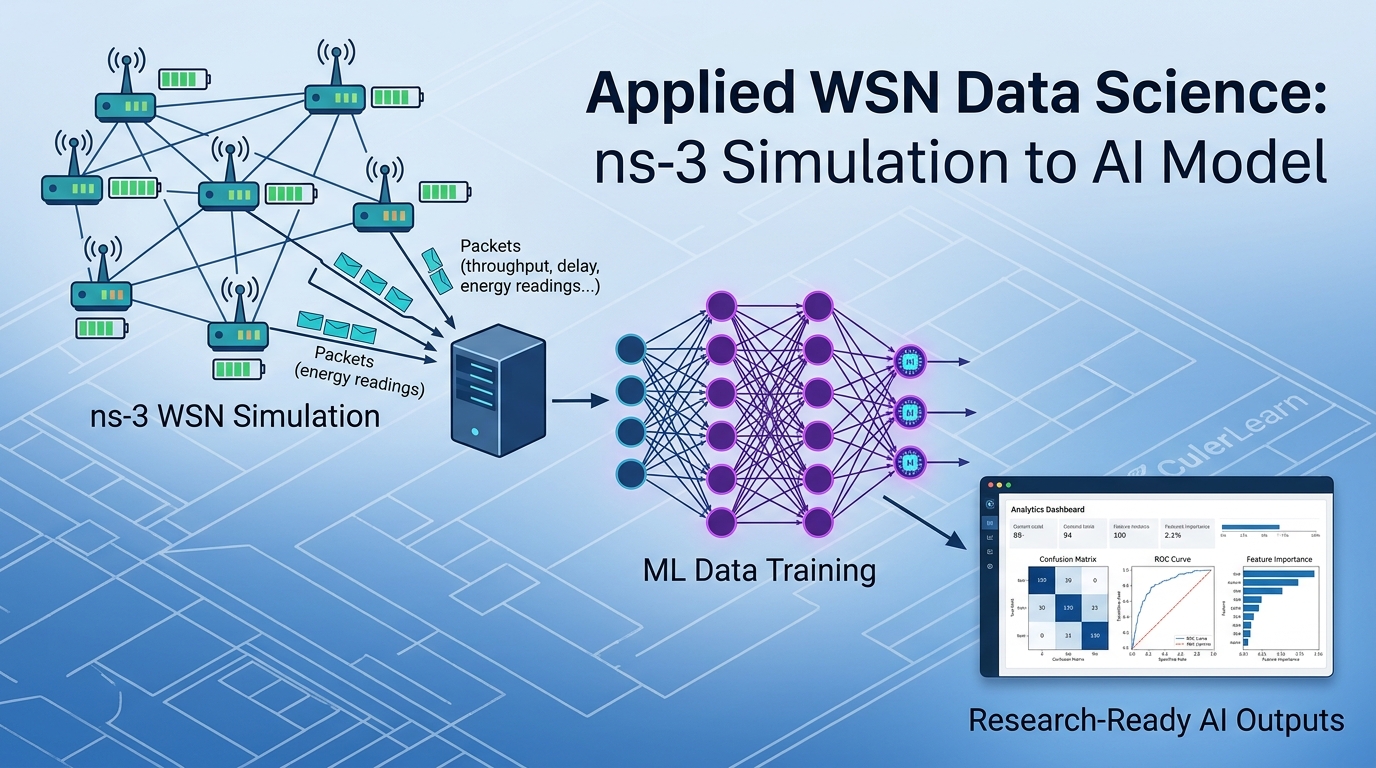
Transform raw telecom configurations into actionable AI models. This masterclass bridges the gap between network simulation and data science. Designed by a Systems Engineer (PhD), this course walks you step-by-step through configuring Wireless Sensor Networks (WSN) in ns-3, automating parameter sweeps to extract rich telemetry data, and training predictive Machine Learning models to optimize network performance.
By the end of this course, you will have built a complete, reproducible end-to-end research pipeline—from C++ simulation scripts to trained PyTorch/Scikit-Learn models—that you can immediately adapt for your thesis, journal publications, or industry R&D projects.
Who This Course Is For
- PhD Candidates & Postdocs in Telecoms or CS who need validated, publication-ready datasets.
- Master’s Students working on WSN, IoT, or 5G/6G wireless network dissertations under tight deadlines.
- R&D Systems Engineers evaluating AI-driven network optimization before hardware deployment.
- Data Scientists seeking specialized experience with synthetic telecommunications data.
Prerequisites
- Basic understanding of networking concepts (IP, MAC protocols, wireless topologies).
- Foundational C++ (for ns-3 script setup) and Python (for data processing).
- Basic familiarity with Machine Learning concepts (all ML pipelines are built step-by-step).
What You Will Learn
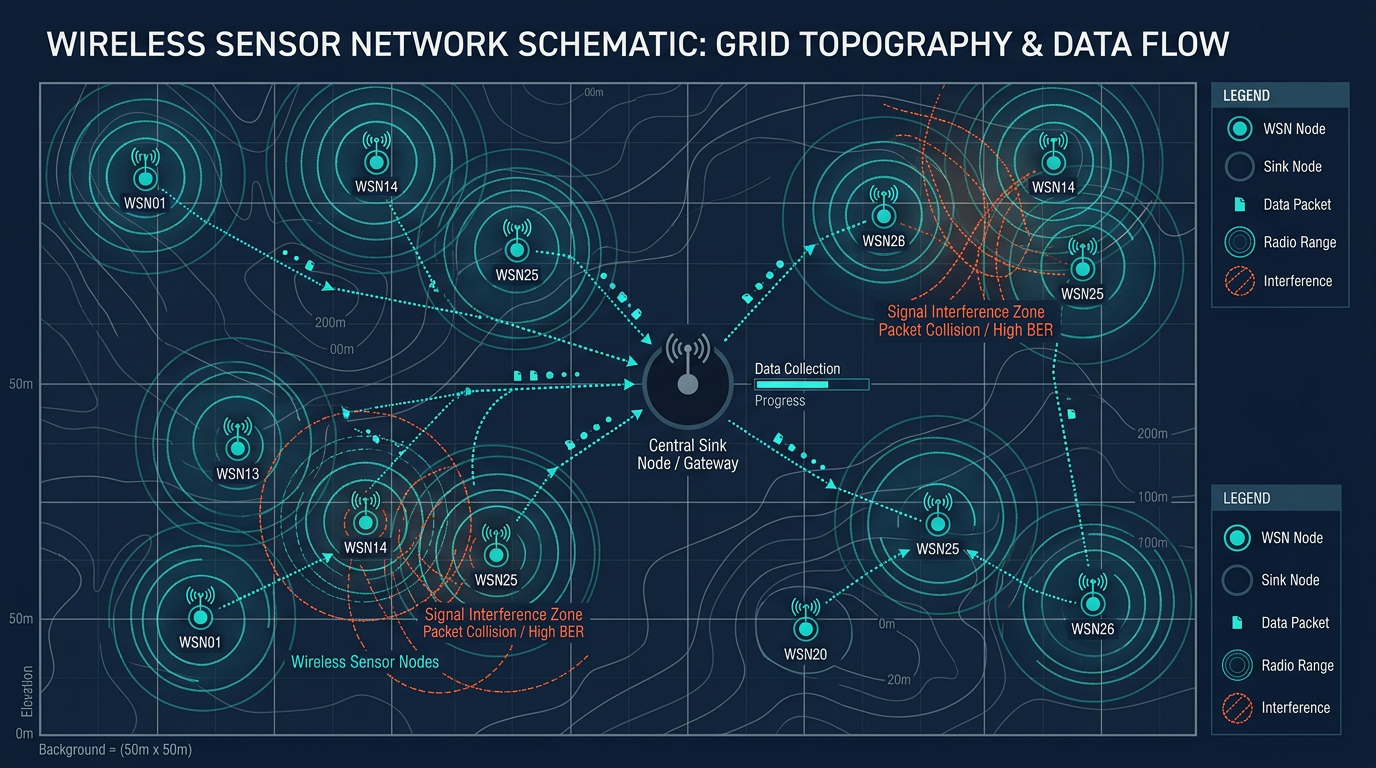
- ns-3 WSN Architecture: Build realistic sensor networks using low-power wireless devices, custom battery models, and dynamic mobility profiles.
- Telemetry & Trace Mining: Tap into ns-3 trace sources to log RSSI, packet drops, channel delay, and energy depletion rates into structured formats.
- Automated Data Generation: Write Python orchestrator scripts to run Monte Carlo sweeps across random seeds, node densities, and traffic patterns.
- ML Data Engineering: Clean, aggregate, and engineer time-series and spatial feature sets using Pandas and NumPy.
- Predictive Model Training: Train decision trees, XGBoost classifiers, and PyTorch neural networks in Jupyter Notebooks to predict node failures and anomalous traffic.
- Research Validation: Implement statistical confidence controls, seed management, and publication-standard visualizations using Matplotlib and Seaborn.
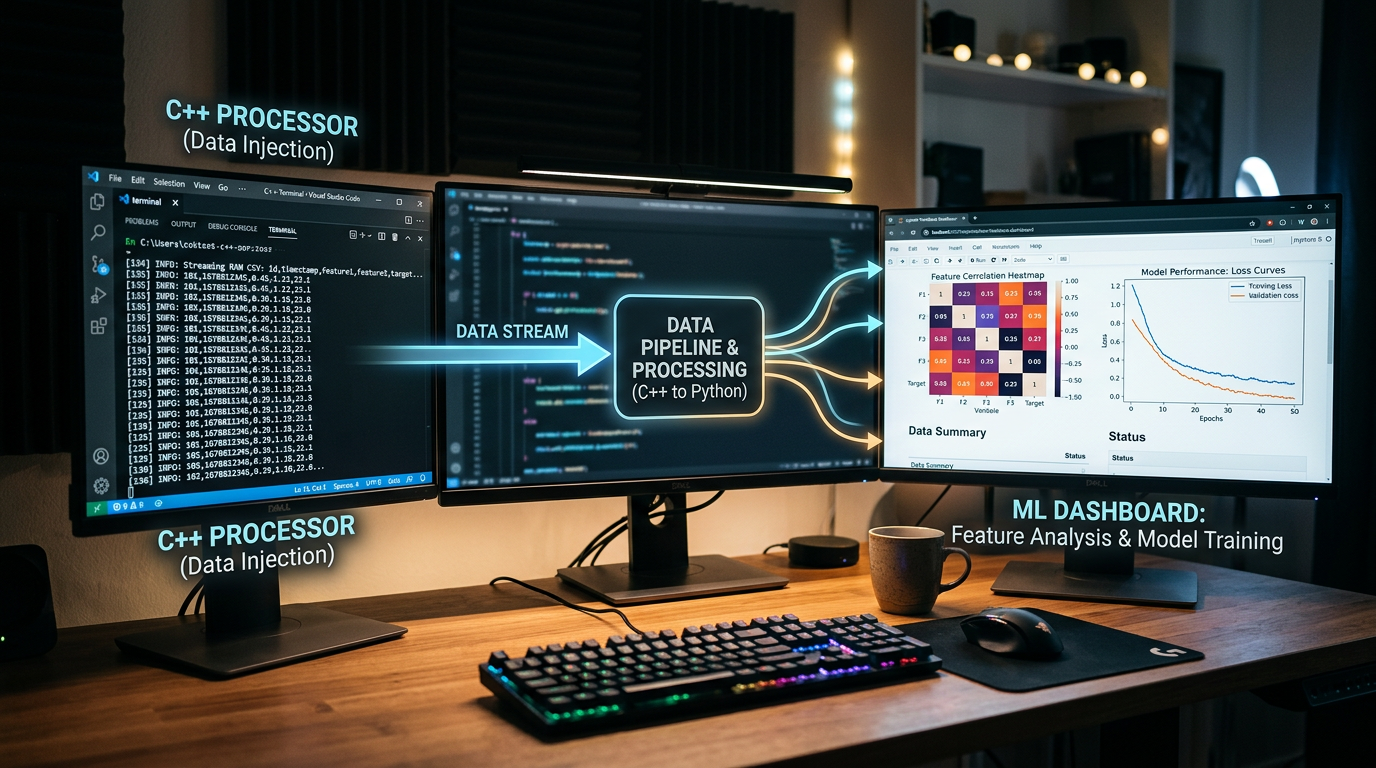
Visual Research Workflow


Detailed Module Syllabus
Module 1: Environment Setup & WSN Modeling Fundamentals
- Lesson 1.1: Setting up a reproducible environment (VS Code, C++ toolchain, Python venv, and Jupyter).
- Lesson 1.2: Building WSN topologies using
ns3::NodeContainerand IEEE 802.15.4 / Low-Power Wi-Fi models. - Lesson 1.3: Integrating node energy sources (
ns3::BasicEnergySource) and battery consumption models. - Lesson 1.4: Configuring spatial node deployment: Fixed sensor arrays vs. mobile collector sinks.
Module 2: Traffic Injection & Custom C++ Data Tracing
- Lesson 2.1: Generating application traffic: Constant bit-rate telemetry vs. event-triggered burst traffic.
- Lesson 2.2: Simulating real-world network anomalies (interference, node failure, sinkhole/jamming attacks).
- Lesson 2.3: Tapping into internal ns-3 state vectors using
Config::Connecttrace sources. - Lesson 2.4: Writing custom C++ data loggers to stream clean CSV datasets during simulation execution.
Module 3: Automated Parameter Sweeps & Synthetic Dataset Pipelines
- Lesson 3.1: Automating ns-3 binary runs using Python CLI wrappers (
CommandLine cmd). - Lesson 3.2: Managing RNG states (
RngSeedManager) for multi-run Monte Carlo statistical validity. - Lesson 3.3: Batch processing, aggregating, and cleaning multi-node simulation logs in Pandas.
- Lesson 3.4: Engineering feature spaces: Rolling averages, spatial node density, and energy depletion rates.
Module 4: Machine Learning Pipeline in Jupyter Notebooks
- Lesson 4.1: Formulating the research ML problem (Predicting battery exhaustion & anomaly detection).
- Lesson 4.2: Exploratory Data Analysis (EDA) and feature correlation in Jupyter.
- Lesson 4.3: Training supervised classifiers (Random Forest, XGBoost) for network state prediction.
- Lesson 4.4: Training Deep Learning models (PyTorch) for sequential time-series forecasting.
Module 5: Research Rigor, Visualizations & Closed-Loop Control
- Lesson 5.1: Evaluating ML precision, recall, and ROC curves against holdout ns-3 test runs.
- Lesson 5.2: Rendering publication-grade vector plots with Matplotlib and Seaborn.
- Lesson 5.3: Advanced: Closed-loop control concepts—feeding ML inferences back into ns-3 runtime.
- Lesson 5.4: Structuring your codebase and documentation for academic paper submission.
Included Course Assets
- Full C++ ns-3 Scripts: Pre-built, tested
.ccfiles for sensor networks and battery tracking. - Python Sweeper Tools: Modular Python scripts to automate multi-seed execution.
- Starter Jupyter Notebooks: Complete
.ipynbnotebooks pre-loaded with data loading, training, and plotting routines. - Sample WSN Datasets: Ready-to-use CSV datasets so you can practice training ML models immediately without waiting for simulation runs.
Instructor

Curriculum
You May Like

Blender 2: Intermediate
Blender 2 builds on Blender 1. You make a mug from scratch, copy it, and finish with colour, light and a polished picture. Each lesson...

Computer Vision 1: Using YOLO
Build your first computer vision project. In five short lessons, you set up YOLO and make it find things in your own photo.

The Learning Mindset
Most people who struggle to learn are not short of ability. They are short of the right conditions: a settled mind, a clear reason and...

Python 2: Foundations for the Age of AI
This course takes your Python further. You already know the basics from Python for Beginners 1. Now you learn to plan your code, keep it...

Python 1: Foundations for the Age of AI
Many people try Python, get lost, and give up. This course takes a different route. You start with a pen and paper, not a computer....
Course Features
- Lectures 21
- Quiz 0
- Duration 10 weeks
- Skill level All levels
- Language English
- Students 0
- Certificate No
- Assessments Yes