
Rigging and Animating a Creature in WebGL – From Blender to a Playable Three.js Game
Learn object-oriented programming, and how to break a game or any piece of software into components, by building a complete game from scratch. You model, rig and animate a four-legged crab in Blender, then write the game class by class …
Overview
Learn object-oriented programming, and how to break a game or any piece of software into components, by building a complete game from scratch. You model, rig and animate a four-legged crab in Blender, then write the game class by class in Three.js and put it online. The whole pipeline is in one project: every asset made by you, every class with one clear job, and a finished result that other people can play.
Founding Student Price: £15 for the first 30 students, or until 30 November 2026, whichever comes first. Use the code CRABSALELAUNCH at checkout. The price is £35 after that. Founding students also get a 15-minute one-to-one session with Dot, to talk about the course, their project and their career goals.
The first 10 lessons are free on YouTube: I have put the first 10 lessons on the CulerDamage YouTube channel, so you can try the course and see how it is taught before you buy. Start with Lesson 1 on YouTube. The channel also has more of my 3D modelling and game projects: youtube.com/@culerdamage.
Learn Object-Oriented Programming by Building
The main skill this course teaches is how to write software as a set of components. You do not need to have used classes or OOP before. Every class has one job, such as loading a model, tracking distance, keeping time or drawing the HUD. You will see why each one exists before you write it, then watch it run in a game you can play.
Components and Software Design
By the end you will know how to split a large program into small, separate parts, decide what each part owns and what it hands to the others, and add a feature without breaking what already works. You will learn how classes depend on each other cleanly, how to refactor working code safely, and how to plan and document a system with a class diagram so that you can return to it later. These skills apply to any game or application, in any language, and the crab is the project you practise them on.
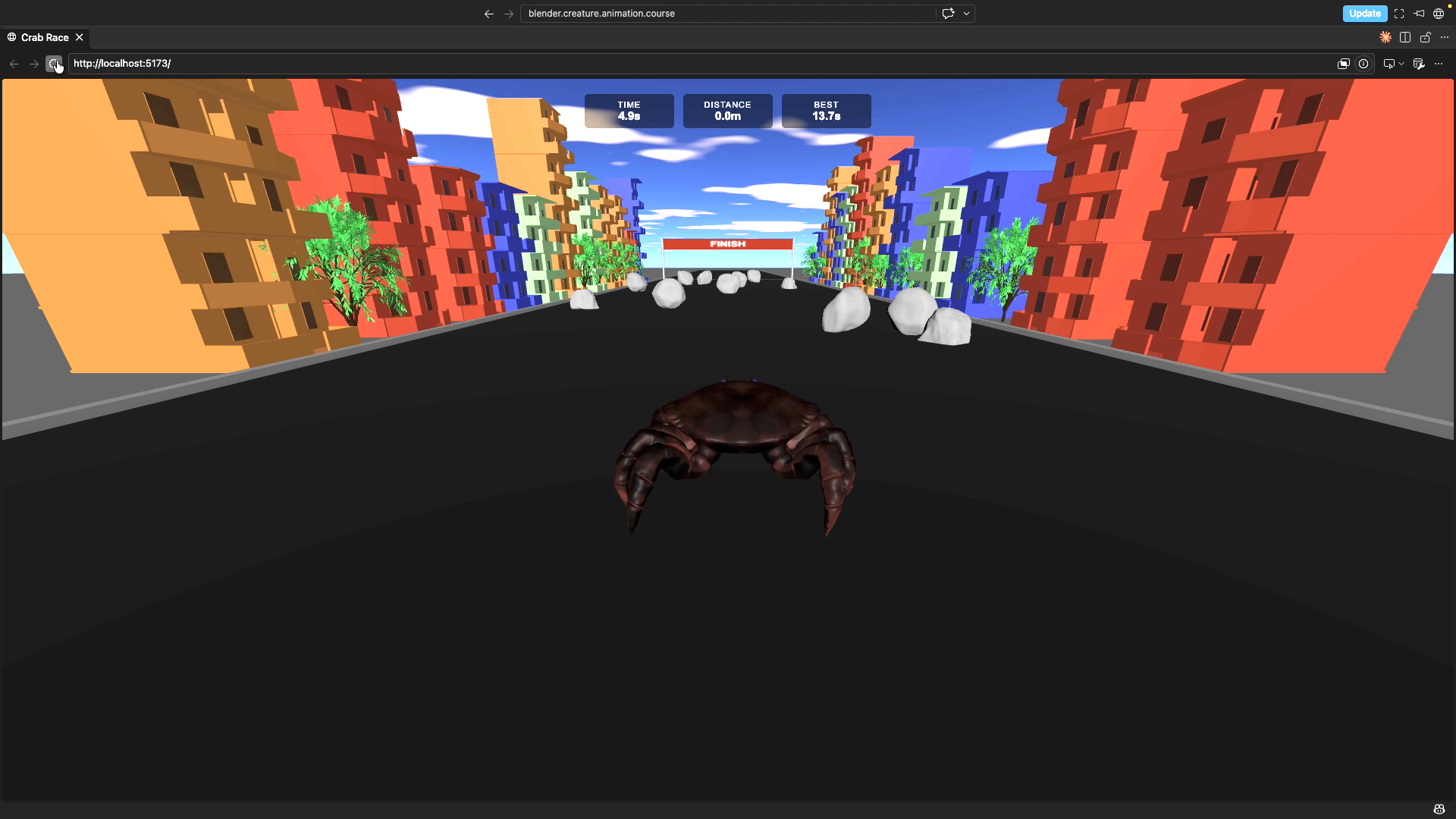
The detailed crab at the start of the course, facing the street.
Course Structure
The course has five modules, each building on the last:
- Module 1: Modelling and Rigging in Blender. Model a four-legged creature, build a bone structure across four independent legs, animate it and export it for the web.
- Module 2: Building the Three.js Application. Load the model and build the scene class by class, with movement and controls. The real bugs are explained as they happen.
- Module 3: Building the Crab Game. Distance tracking, touch-friendly controls, a city street with buildings and randomised obstacles, a timed run to a finish line with a personal best, and a sky.
- Module 4: Finishing the Game. Keep the crab on the street, add a smoothed camera, a polished HUD, a start screen with instructions, and sound.
- Module 5: Final Modelling Pass. Back in Blender, sculpt, retopologise, rig, animate and texture a detailed crab, then model buildings and trees. Back in Three.js, finish the game world, update the game for phones and tablets, and put it online at your own address. A final lesson sets exercises and challenges for you to try on your own.
What You Will Build
A rigged and animated crab, a street lined with buildings, trees and rocks you model yourself, and a finished timed game with a HUD, a start screen, sound and a personal best, running in the browser, tested on phones and tablets, and deployed online.
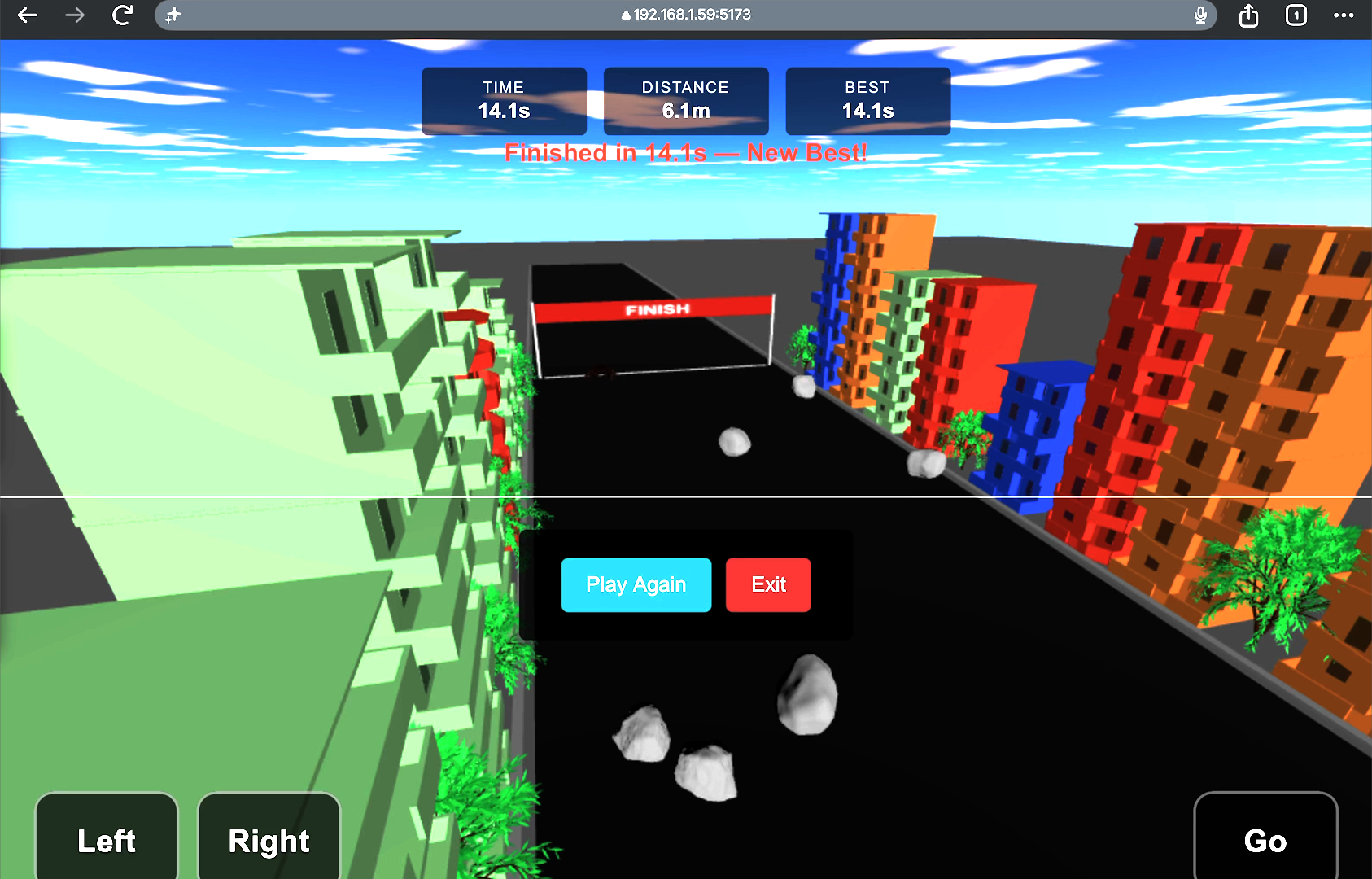
Looking into the course at the finish line from above the buildings.
Documentation You Can Keep
Each code lesson includes a lesson plan, tasks to complete, the code on the lesson page, and a class diagram showing how the new pieces connect to what you have already built, to print or keep on a second screen. A troubleshooting guide covers the real errors met during the build.
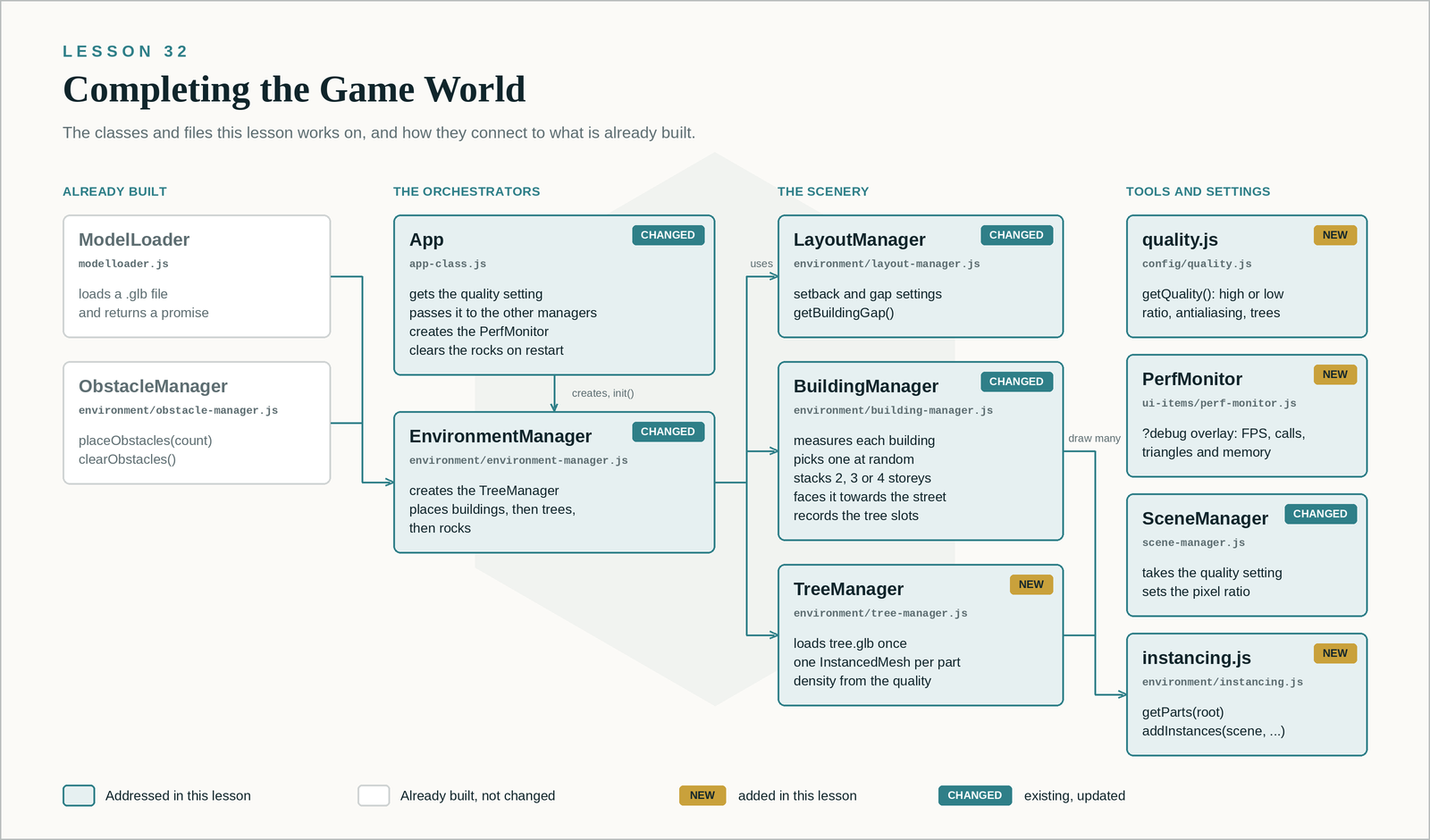
A class diagram from Lesson 32. Click it to open it full size.
How AI Tools Fit In
The Three.js lessons use AI-assisted coding in VS Code for setup and boilerplate you already understand the purpose of. Every generated snippet is explained, so you learn where it helps and where the decisions are still yours.
Your Tutor
Dotun Omosebi, Ph.D, (Dot), is a former Lecturer in Games Programming at Edge Hill University in the UK. With a PhD in wireless sensor networks and AI, and more than twenty years as a systems design engineer and software developer, the course draws on teaching, research and industrial experience. Modelling and animation in Blender and ZBrush sit alongside that work.
Format
Self-paced video lessons: 33 video lessons, more than seven hours in all, and a final exercises lesson across five modules, with the code and a class diagram on every coding lesson page. The first 10 lessons are also free to watch on YouTube. Modules 1 and 2 open when you register. Modules 3, 4 and 5 unlock on days 7, 14 and 21 after registration, so that you can study at a steady pace. Access does not expire. You can also follow your course on your phone with the CulerLearn app.
Get the CulerLearn app for Android to follow the course on your phone, with your progress kept in step with the website:

Alongside the lessons you get a set of course resources: a guide to the three ways of working through the course, a troubleshooting reference for the early lessons, and prompts for generating your own game sounds. See the course resources.
Prerequisites
Basic familiarity with Blender’s interface, and basic JavaScript: variables, functions, conditions and loops. You do not need to know classes, Promises or Three.js, because each is explained as it comes up. Blender, Node.js and VS Code are all free.
Refunds
You can cancel within 14 days of buying the course and receive a full refund. You do not need to give a reason. Modules 3 and 4 unlock within the refund period, so you can see most of the course before you decide; Module 5 unlocks on day 21. See our Refund and Cancellation Policy for the full terms.
Privacy Policy · Refund and Cancellation Policy · Data Usage Policy
Instructor

Curriculum
Curriculum
- 5 Sections
- 34 Lessons
- Lifetime
- Module 1: Modelling and Rigging in Blender2 ItemsModelling and Rigging in Blender. Model a four-legged creature, build a bone structure across four independent legs, animate it and export it for the web.
- Module 2: Building the Three.js Application10 ItemsBuilding the Three.js Application. Load the model and build the scene class by class, with movement and controls. The real bugs are explained as they happen.
- 2.1Lesson 3: Exporting the GLTF Model20 Minutes
- 2.2Lesson 4: Creating the Three.js Scene30 Minutes
- 2.3Lesson 5: Loading the Model20 Minutes
- 2.4Lesson 6: Creating the Environment20 Minutes
- 2.5Lesson 7: Building the Animation
- 2.6Lesson 8: Creating the Character Controller
- 2.7Lesson 9: Building the Character Controller
- 2.8Lesson 10: Integrating the Character Controller
- 2.9Lesson 11: Creating the Idle Animation
- 2.10Lesson 12: Reworking the Walk Animation
- Module 3: Building the Crab Game8 ItemsBuilding the Crab Game. Distance tracking, touch-friendly controls, a city street with buildings and obstacles, a timed run to a finish line with a personal best, and a sky.
- Module 4: Finishing the Game5 ItemsFinishing the Game. Keep the crab on the street, add a smoothed camera, a polished HUD, a start screen with instructions, and sound.
- Module 5: Final Modelling Pass9 ItemsFinal Modelling Pass. Back in Blender to model and rig a detailed crab and add trees, then deploy the game and test it on mobile devices.
- 5.1Lesson 26: Sculpting the Detailed Crab
- 5.2Lesson 27: Sculpting and Retopology of the Detailed Crab
- 5.3Lesson 28: Rigging the Detailed Crab
- 5.4Lesson 29: Animating the Detailed Crab
- 5.5Lesson 30: Texturing the Crab
- 5.6Lesson 31: Creating Buildings and Trees
- 5.7Lesson 32: Completing the Game World
- 5.8Lesson 33: Updating the Game for Mobile Devices
- 5.9Lesson 34: Exercises and Challenges
Requirements
- A Windows or Mac computer capable of running Blender and a code editor
- Blender, Node.js and VS Code installed (all free)
- Basic familiarity with Blender's interface
- Basic JavaScript: variables, functions, conditions and loops
- No rigging, animation or Three.js experience needed, and no prior knowledge of classes or Promises
Features
- The whole pipeline in one project, from a blank Blender scene to a game people can play online
- Learn object-oriented programming by building a real game, class by class
- Design before code: every class has one job, explained before it is written
- Lesson plans, tasks and class diagrams to print or keep beside the video
- Genuine bugs hit during the build documented and explained as they happened, not edited out
- AI-assisted coding shown openly, with the reasoning behind every decision
- Full project files and a starter repository on GitHub
- A 14-day full refund, with no reason needed
Target audiences
- Learners new to object-oriented programming who want to see it used in a real project
- Blender users who want to see their models rigged, animated and moving in a real game
- Developers interested in Three.js who want a genuine end-to-end project, not an isolated code snippet
- Anyone with basic JavaScript who wants to go from simple scripts to structuring a complete project
- Anyone wanting to see how AI-assisted coding actually fits into a real build, decisions explained, not just handed over
You May Like

Blender 2: Intermediate
Blender 2 builds on Blender 1. You make a mug from scratch, copy it, and finish with colour, light and a polished picture. Each lesson...

Computer Vision 1: Using YOLO
Build your first computer vision project. In five short lessons, you set up YOLO and make it find things in your own photo.

The Learning Mindset
Most people who struggle to learn are not short of ability. They are short of the right conditions: a settled mind, a clear reason and...

Python 2: Foundations for the Age of AI
This course takes your Python further. You already know the basics from Python for Beginners 1. Now you learn to plan your code, keep it...

Python 1: Foundations for the Age of AI
Many people try Python, get lost, and give up. This course takes a different route. You start with a pen and paper, not a computer....
Course Features
- Lectures 34
- Quiz 0
- Duration Lifetime access
- Skill level Intermediate
- Language English
- Students 3
- Certificate Yes
- Assessments Self