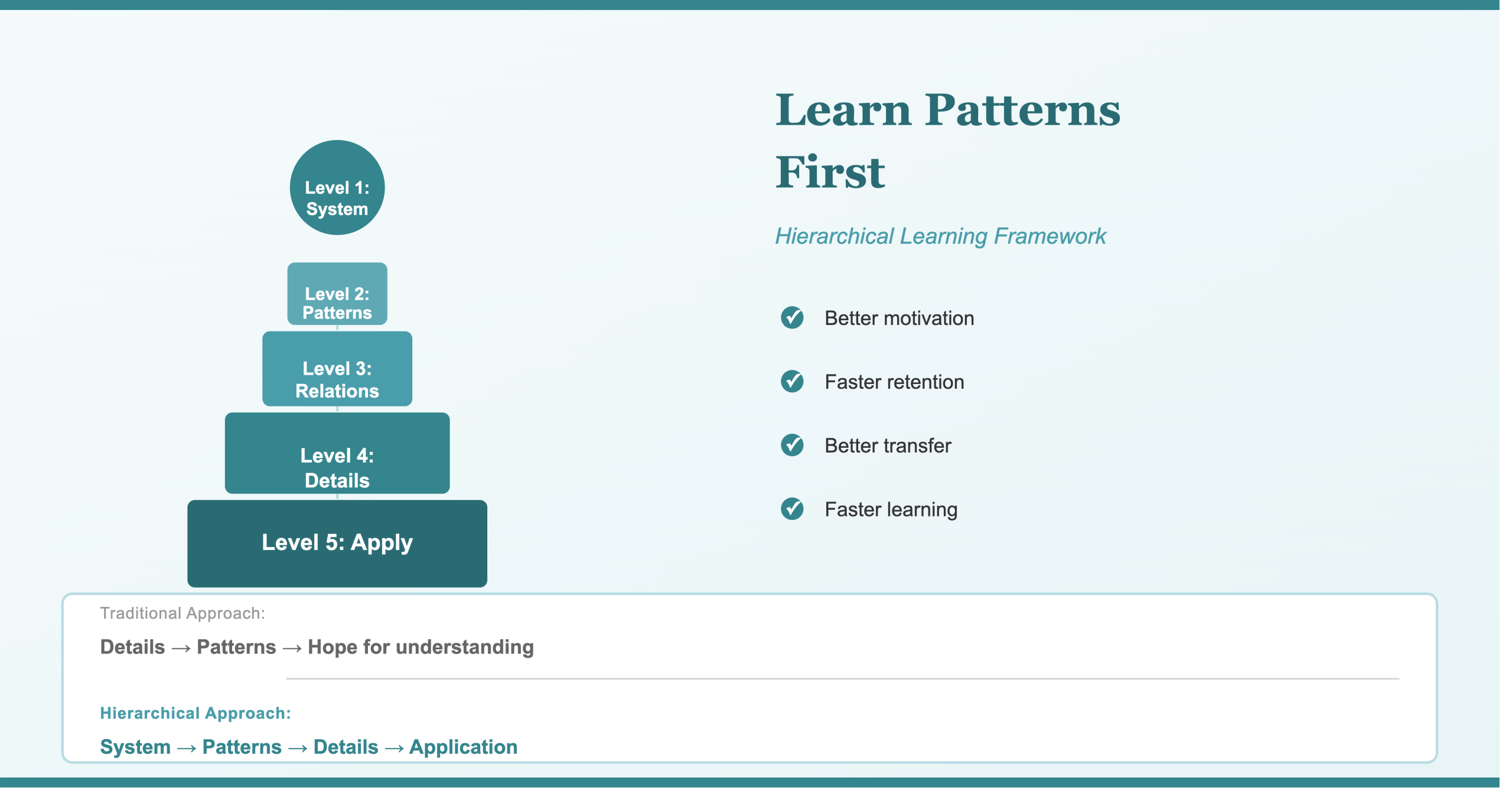
Learn the Patterns First: How Hierarchical Learning Accelerates Skill Development
Why drilling down into details works better when you understand the system first
Most people learn backwards. They begin by memorising facts, mastering techniques, and drilling details - then hope the big picture eventually emerges. By the time they understand how everything connects, they have already invested hundreds of hours in disconnected information.
There is a fundamentally different approach: learn the patterns first, understand the system, then drill down into the details. This hierarchical learning method is how expert learners accelerate their progress. It is also how you can transform skill development from a slow accumulation of facts into a coherent, interconnected body of knowledge.
The difference is not academic. Adult learners who apply hierarchical learning report faster skill acquisition, better retention, and more effective real-world application. Career changers find it easier to build credibility in new fields. People returning to education after years away discover they can learn more effectively than they did in school.
This post explores how to restructure your learning process around systems thinking, pattern recognition, and strategic detail work.

The Problem With Bottom-Up Learning
Traditional education, and most online courses, follow a linear, detail-first approach. You start with fundamentals, progressively layer on complexity, and eventually (theoretically) reach mastery.
On paper, this makes sense. You cannot understand advanced concepts without first understanding the basics. Building from the ground up seems logical.
In practice, this approach has critical limitations.
The Motivation Problem
When you begin with foundational details, you do not yet understand why those details matter. You are memorising rules without seeing the system they serve. You spend weeks on concepts whose relevance remains invisible until much later in the course.
This creates what researchers call "inert knowledge" - facts you know but cannot connect to anything meaningful. You study photosynthesis but do not yet understand ecosystems. You memorise Python syntax but do not yet understand what you can build. You learn accounting rules but do not yet understand how they reflect business reality.
Motivation collapses when you cannot answer "why am I learning this?" with genuine conviction.
The Retention Problem
Facts learned in isolation are forgotten in isolation. Neuroscience research demonstrates that information retained only as isolated facts (versus integrated into a larger system) is far more likely to be forgotten. Without contextual connections, your brain has fewer reasons to keep the information around.
You study the details of a software framework. Three months later, without having applied it, the details evaporate. You learned them, but they did not integrate into a coherent framework in your mind. Compare this to someone who first understood what the framework does (at the system level), then understood why it does those things, then learned the details - they are far more likely to retain what they learned.
The Transfer Problem
Details learned without system understanding do not transfer to new contexts. You master React for building web user interfaces, but when you encounter Angular or Vue, you start nearly from scratch. The details were specific to React; the underlying patterns never integrated into your thinking.
Contrast this with learning React through the lens of "component-based architecture" and "state management patterns." Now when you encounter Angular, you recognise the same patterns in different syntax. The skills transfer because you learned the system, not just the details.
How Hierarchical Learning Works
Hierarchical learning reverses the traditional sequence. You start by understanding the system at a high level, then progressively zoom in to details, always maintaining clarity about how each detail fits into the larger structure.
Think of it as learning geography by first understanding continents and major regions, then countries, then cities, then neighbourhoods - versus learning by starting with street-level details and hoping to assemble them into continents.
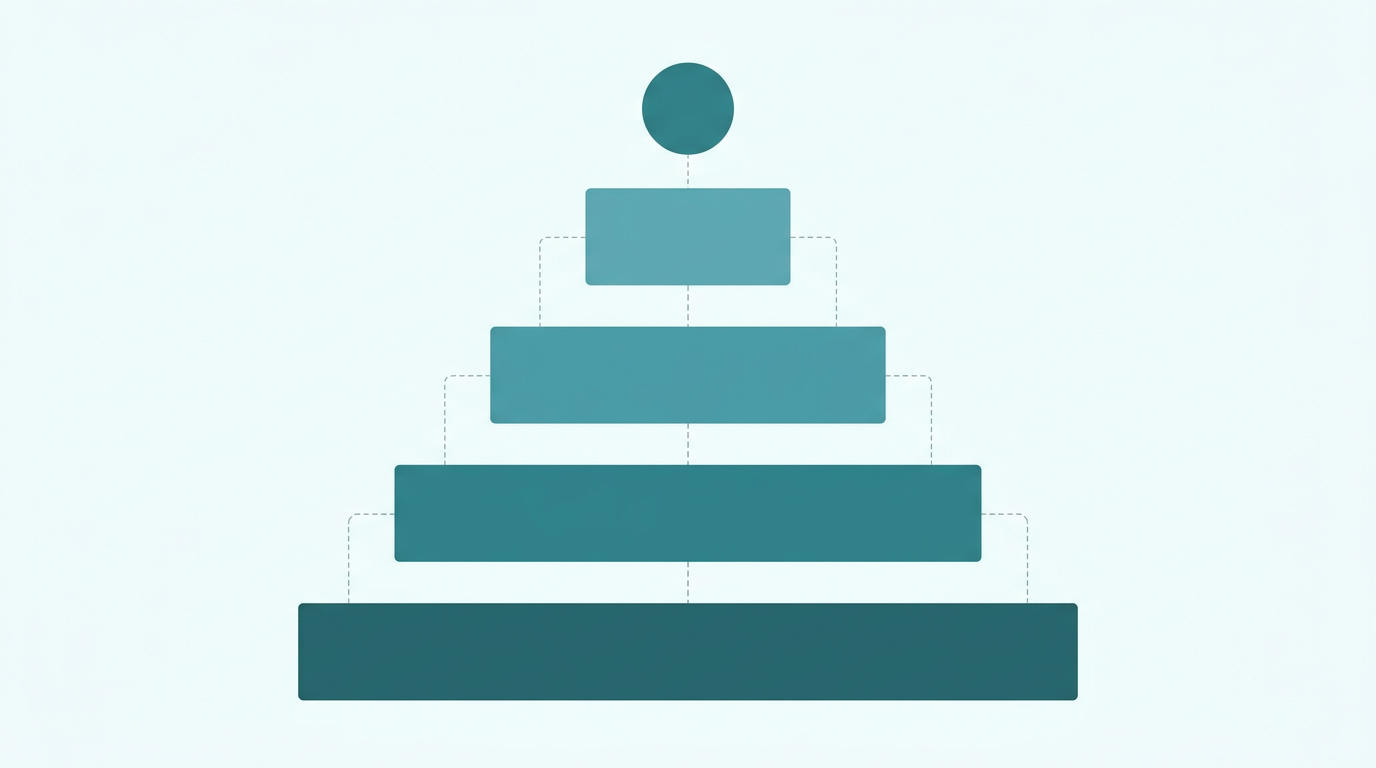
Level 1: The Conceptual System
Begin by understanding what you are learning and why it exists. Not the details - the overall purpose and architecture.
If you are learning Python, do not start with syntax. Start with: "Python is a programming language designed for clarity and rapid development. It allows you to give instructions to computers in a human-readable way. You use it to automate tasks, analyse data, or build applications." You understand the system.
If you are learning financial accounting, do not start with journal entries. Start with: "Accounting is a system for tracking the financial health of an organisation. It records where money comes from, where it goes, and the overall financial position. These records help businesses make decisions and stay compliant with regulations." You understand the system.
At this level, you build motivation. You understand why this field exists and why someone would invest time learning it.
Level 2: The Major Patterns
Once you understand the system, identify the major patterns that organise that system. These are the recurring themes, the fundamental structures that everything else builds from.
In Python: variables and data types (how you store information), functions (how you organise reusable code), loops (how you repeat actions), and conditionals (how you make decisions). These are the major patterns. Do not yet learn the minute details of each - understand what each does and why the system needs it.
In financial accounting: the fundamental equation (assets equals liabilities plus equity), the accounting cycle (how transactions flow through the system), and the three financial statements (the different ways of viewing financial health). These are the major patterns.
At this level, you build understanding of structure. You see how the system is organised.
Level 3: Pattern Relationships
Before drilling into details, understand how the major patterns relate to each other. How do they interconnect? When does one take priority? What is the sequence in which you use them?
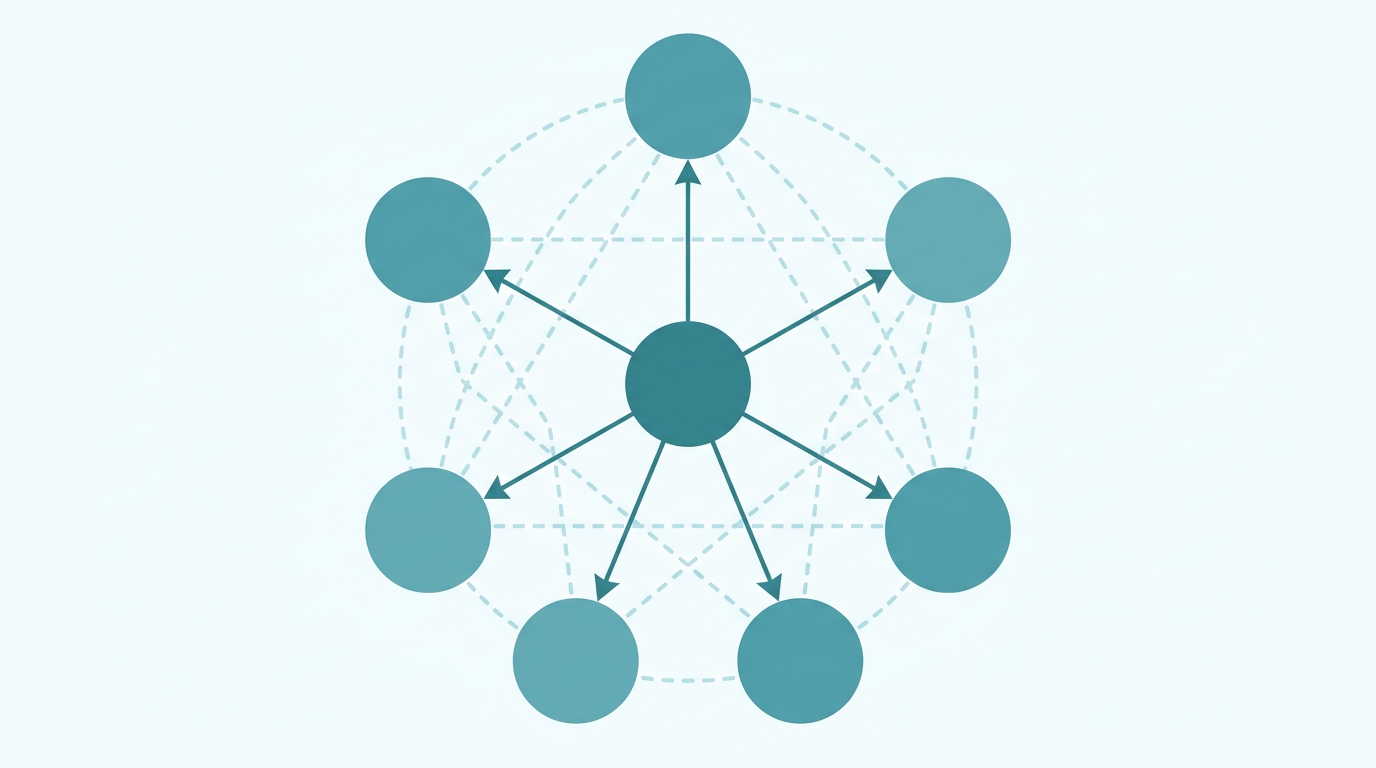
In Python: you understand that functions use variables, that loops often contain conditionals, that data types determine what operations you can perform. You see the relationships without yet needing to know the exact syntax.
In accounting: you understand that the accounting cycle produces the financial statements, that the fundamental equation constrains every transaction, that different transactions flow through different parts of the cycle.
At this level, you build integration. You see the system as a coherent whole rather than disconnected pieces.
Level 4: The Detailed Rules
Only now, when the system, major patterns, and relationships are clear, do you drill into the specific, detailed rules and syntax. But now these details are not isolated facts. They are implementations of patterns you already understand.
You learn Python syntax for loops - but you already understand what loops do and why the system needs them. You learn the specific journal entry format - but you already understand how transactions flow through the accounting system.
Details learned at this stage integrate immediately into your existing mental model. Retention improves. Transfer improves. Understanding deepens.
Level 5: Applied Mastery and Exceptions
Finally, you apply what you have learned to real problems. This is where details matter most because you now know which details matter for which contexts. You discover exceptions to rules, edge cases, and sophisticated applications that only emerge when you actually use the knowledge.
At this level, you move from "I know this" to "I can do this" to "I understand when and why to do this."
Hierarchical learning is not about knowing less. It is about understanding more by learning in the order that builds coherence rather than accumulation.
Why This Works: The Cognitive Science
Why does hierarchical learning work? It is not just better intuitively - there is solid cognitive science explaining why this approach aligns with how human brains actually learn.
Schema Formation
Your brain does not store isolated facts. It organises knowledge into schemas - mental frameworks that integrate related information. When you learn something new, your brain asks: "Where does this fit in my existing schemas? What patterns does this follow?"
Bottom-up learning fights this process. You are feeding your brain isolated facts before the schema exists. Your brain struggles to find a place for the information.
Hierarchical learning cooperates with this process. You build the schema first (the system, the patterns, the relationships), then populate it with details. Each new detail has a clear place in the existing structure.
The Primacy Effect
Information encountered first is remembered longer and has disproportionate influence on how subsequent information is understood. When you learn the system first, you create a strong primary framework. Subsequent details are interpreted through this lens and stick more readily.
Contrast this with detail-first learning, where you begin with arbitrary, disconnected facts. The primacy effect works against you - the earliest details are often the most arbitrary and have the least context.
Cognitive Load
Your working memory has limited capacity. When you try to memorise details without understanding their context, you are using working memory inefficiently. Each detail requires conscious attention and effort to hold in mind.
When you understand the system first, you can compress multiple details into a single concept. Instead of memorising ten separate SQL commands, you understand "SQL is a language for querying databases following certain logical structures." The ten commands are now variations on concepts you already hold, reducing cognitive load.
Transfer and Application
Research on expertise shows that experts do not simply know more facts than novices - they organise their knowledge around deeper principles and patterns. This organisation enables flexible application to new problems.
When you learn hierarchically, you are building the knowledge structure that experts naturally develop. You are not starting as a novice accumulating facts; you are learning the way experts think.
Applying Hierarchical Learning in Practice
Understanding the theory is one thing. Implementing it requires restructuring how you engage with learning materials and design your learning path.
Step 1: Identify the System
Before opening any course or textbook, spend time understanding what you are about to learn at the highest level.
Ask: What is this field or skill? What problem does it solve? Why does it exist? What is its purpose? How is it structured? What are the major domains within it?
For this information, read overviews, watch introductory videos, read Wikipedia articles, or listen to podcasts about the field. Spend hours here if necessary. You are not memorising details - you are building a conceptual map.
This step is often skipped because it feels like "not real learning." It is. It is the most important step.

Step 2: Map the Major Patterns
Now identify the five to ten major patterns or concepts that organise the field. These are the big ideas that everything else builds from.
Do not attempt completeness. Do not memorise details. Identify the recurring themes that appear across different resources. What concepts appear in every introduction? What ideas come up repeatedly?
Write these down. Create a simple visual (a diagram, a mind map, a list with connections) showing these patterns.
Step 3: Understand Relationships
Before diving into any single pattern deeply, understand how all the patterns relate to each other. Which comes first? Which depends on which? What is the flow?
Create a diagram showing these relationships. Add sequence arrows if there is an order. Add dependency lines if one pattern requires understanding another.
This step moves you from understanding isolated patterns to understanding the system as a coherent whole.
Step 4: Choose One Pattern and Drill Down
Now you can begin detail work. But you do it strategically. Choose one pattern, understand it deeply, then move to the next. You do not study all patterns at surface level before going deep - that loses the integration benefit.
For each pattern: learn the major concepts within it, then the specific techniques or rules, then practice applying them.
Critical: always maintain awareness of how this pattern fits into the larger system. Reference back to your hierarchy frequently.
Step 5: Integrate Through Application
As you learn each pattern, apply it to real problems. Do not wait until you have learned everything before applying anything.
Application serves two critical functions: it integrates the details into your mental model, and it reveals which details actually matter in practice.
Your Hierarchical Learning Framework
Level 1 (System): Spend 2-5 hours understanding what you are learning and why it exists.
Level 2 (Patterns): Identify the 5-10 major patterns. Spend 2-3 hours mapping these.
Level 3 (Relationships): Spend 2-3 hours understanding how the patterns connect.
Level 4 (Details): For each pattern, spend focused time learning the specific rules, techniques, and implementations.
Level 5 (Application): Apply throughout the learning process. Do not delay application until "mastery."
Real-World Examples
Example 1: Learning a Programming Language
Traditional (bottom-up): Start with variables, data types, operators, then functions, then loops, then classes. Spend weeks memorising syntax. By the time you understand what you can build, motivation has often collapsed.
Hierarchical (top-down): Start by understanding "Programming is giving instructions to computers to solve problems." Understand that all programs manage data, make decisions, and repeat actions. Understand that different languages solve these problems differently but share fundamental patterns. Then learn how your chosen language implements these patterns. Apply by building small programmes early and often.
Time investment: similar. Learning curve: dramatically different. The hierarchical approach builds coherence from the start.
Example 2: Learning Financial Management
Traditional (bottom-up): Learn accounting principles, then double-entry bookkeeping, then balance sheets, then income statements, then cash flow statements. Memorise rules. Hope the overall picture eventually emerges.
Hierarchical (top-down): Start by understanding "Financial management is tracking and optimising money flow within an organisation." Understand that organisations need to know what they own, what they owe, and how profitable they are. Understand that financial statements answer these questions. Then learn the specific techniques that produce those statements.
The hierarchical learner understands why balance sheets matter before learning how to build them. Motivation and retention improve immediately.
Example 3: Learning a New Career Field
Traditional (bottom-up): Enrol in courses. Work through modules sequentially. Complete certifications. Gradually build understanding.
Hierarchical (top-down): Spend a month reading widely about the field. Understand what problems it solves, what roles exist, what major specialisations exist, what typical career paths look like. Identify the core skills and knowledge that separate beginners from practitioners. Then pursue targeted learning in those specific areas.
The hierarchical approach means you are learning the field intelligently, not just completing courses. You understand from the start where your learning is heading and why.
Personal application: When learning a new tool or framework, spend your first session watching overview videos and reading introductions. Resist the urge to "just start coding." Understand what the tool does and why it exists. On your second session, identify the major patterns. Only then begin detail work. This adds one or two hours to your timeline but compresses weeks of confusion later.
Combining Hierarchical Learning With Spaced Repetition
Hierarchical learning is how you structure knowledge. Spaced repetition is how you retain it. They work together.
Once you have learned details hierarchically, reinforce them through spaced repetition. Review patterns you learned weeks ago before moving to new ones. Reference your system map frequently. Apply old concepts to new problems.
The combination is powerful: hierarchical learning ensures the knowledge is coherent and integrated; spaced repetition ensures it is retained and becomes automatic.
The Inverse Problem: When You Cannot Find the System
Sometimes you cannot find clear system-level information about what you are learning. The field is new, or the available resources do not provide overview-level understanding.
In these cases, create the system yourself.
Read widely across different sources. Talk to people with expertise in the field. Identify patterns across what you read. Build your own mental model of the system. This takes more time, but it is valuable precisely because you are not passively absorbing someone else's structure - you are actively constructing your own understanding.
This is actually superior to following a pre-existing system, because you must think deeply to construct it. The thinking itself deepens your learning.
Hierarchical Learning and Adult Development
Adult learners often have an advantage in hierarchical learning. You have more life experience, more context, stronger motivation tied to real-world applications. You are naturally inclined to ask "why does this matter?" and "how does this fit with what I already know?"
Leverage this. When you feel frustrated by detail-heavy courses, it is often because you are ready for system-level understanding that the course is not providing. Trust that instinct. Seek overview-level information first. Your brain is asking for hierarchical structure.
Career changers, in particular, benefit from hierarchical learning. You already understand work, problem-solving, and professional contexts. You do not need to absorb a field sequentially from scratch. You need to understand how your new field organises knowledge and where it fits with what you already know. Hierarchical learning honours this.
Building Your Learning System
Hierarchical learning is not a technique you apply once. It is a systematic approach to how you engage with any new knowledge.

Design Your Learning Process
For each new skill or field you tackle:
1. Before formal study, spend time understanding the system. Read overviews. Watch introductions. Talk to practitioners. Build a high-level mental map.
2. Create a visual representation of the major patterns and how they relate. This becomes your learning guide.
3. Structure your detailed learning around these patterns. Learn one pattern deeply, then move to the next, always maintaining connection to the whole.
4. Apply continuously. Do not wait for perfection before using what you have learned.
5. Reference your system map frequently. Before learning something new, ask "how does this fit into my understanding?" After learning it, update your map.
This process transforms learning from passive information absorption into active knowledge construction. You are not just learning what experts know. You are learning how experts think about their field.
The Compound Effect
The real power of hierarchical learning emerges over time. Each new skill learned hierarchically builds on your strengthened ability to think hierarchically. Each field you understand deeply teaches you patterns that help you understand the next field faster.
Someone who has learned one field hierarchically can learn a second field in half the time, because they understand the meta-skill of building hierarchical understanding. They know how to identify systems, map patterns, understand relationships, then drill to details.
This is how seemingly "multi-talented" people develop their abilities. It is not that they are innately smarter. It is that they learned early how to learn hierarchically. They apply this approach to each new domain they encounter.
You can do this too. The skill of hierarchical learning is itself learnable. Master the approach, and you unlock the ability to master any new field more quickly and effectively.
Starting Now
If you are currently in the middle of learning something, pause. Before diving deeper into details, take a step back.
Spend a few hours understanding the system. What is the big picture? How is the field organized? What are the major patterns? How do they relate?
Create a simple visual map. Post it where you can see it regularly.
Then return to your detailed learning with this system map as your anchor. Watch how much faster integration happens. How much better retention becomes. How much more effectively you can apply what you are learning.
Learning is not about moving information from books into your head. It is about building integrated, coherent knowledge structures. Hierarchical learning is how you do that efficiently.
Begin with the system. The details will follow more quickly than you expect.
Ready to apply hierarchical learning to your next skill? Start with Step 1 today: spend just 2-3 hours understanding the system. You might be surprised how much faster everything else becomes.

You may also like

Your Personal Brand Started Before You Said a Word