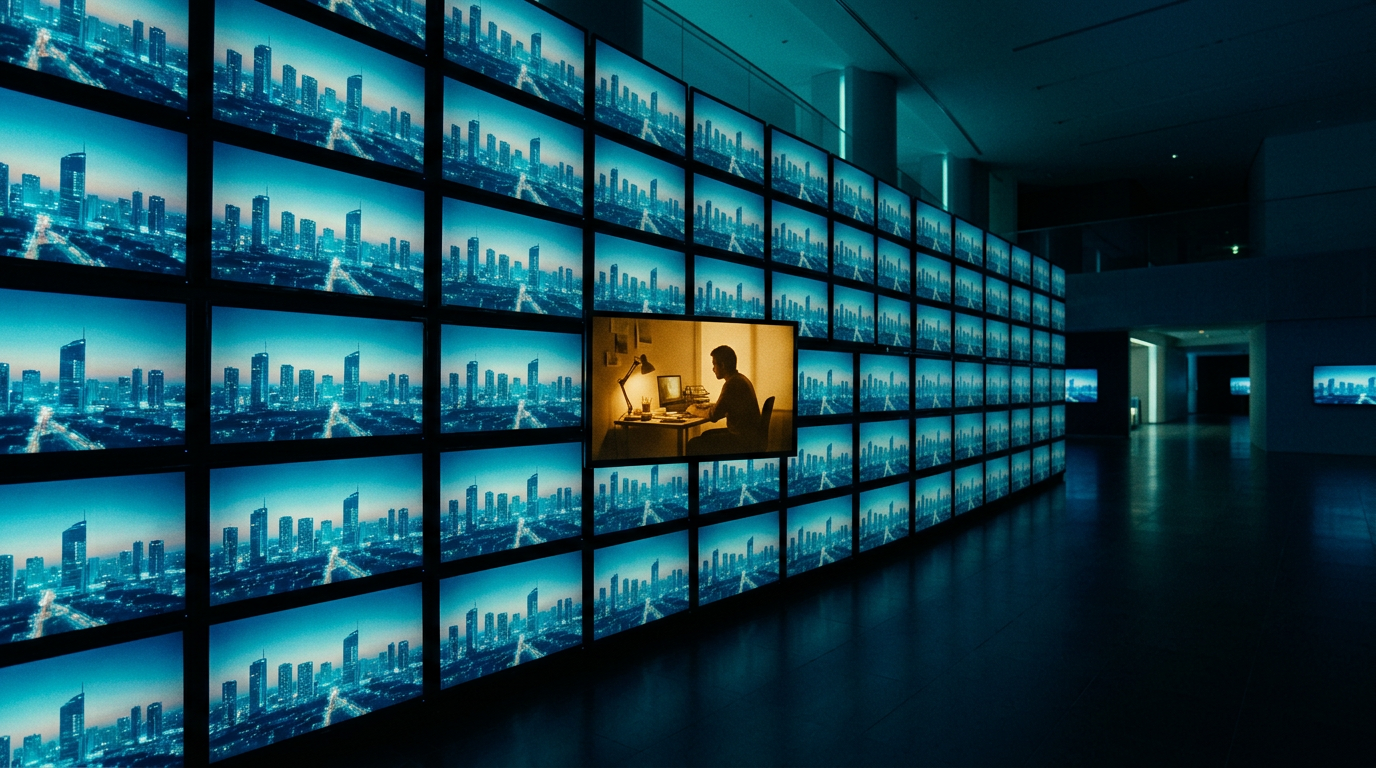
The Paradox of Universal Competence – Part 2: When Everyone Can Make Video
- Date 14 November 2026
- Categories AI World, Artificial Intelligence
- Comments 0 comment
When anyone can make cinematic video from a text prompt, producing more stops being an advantage. What becomes scarce is human trust, a positive return on effort, and video that adapts to the viewer.
Abstract
This article applies the argument of The Paradox of Universal Competence (Part 1) to AI-generated video. It considers four consequences of near-zero production costs: synthetic fatigue among viewers, a falling return on the effort of producing video, a convergence in visual style, and the opportunity to replace fixed video with video that adapts to the individual viewer. The limitations of the argument are then set out. The analysis is a reasoned argument. Its statements about the future are hypotheses, and the one empirical claim it makes is referenced.
1. Introduction
Part 1 set out a simple idea: if AI pushes the cost of making digital goods towards zero, the price of raw digital output may collapse. This article considers what that idea implies for AI video.
If AI video models were to remove the barrier of cost, a natural response would be to produce more video.
The argument of this article is that flooding feeds with synthetic video would not resolve the underlying growth problem, but would relocate the bottleneck. Four places to which it may move are examined below.
2. Synthetic fatigue and the value of a human presence
It is hypothesised that, as feeds, advertisements and training sites fill with polished, prompt-generated clips, audiences may tire of them. This hypothesised effect is termed here synthetic fatigue. If viewers perceive that no human effort went into a message, they may give it very little attention.
In economic terms, it is argued that verifiable human effort is difficult to counterfeit and could therefore function as a scarce signal of credibility. The more automated a feed becomes, the greater the value that signal may carry.
3. The cost of producing video against the attention it earns
The model below assumes that producing a video carries a cost in computing time and in human time spent writing prompts and selecting results. Let Ccompute denote the cost of the computing time needed for one usable video, and Cprompting the cost of the human time spent writing prompts and selecting results. Let Rattention denote what the video earns from viewers' attention. Return on investment (ROI) is the earnings of a video divided by its cost:
The model assumes that viewer attention is limited. If the number of videos (Qvideo) on each platform grows, every video receives a smaller share of that attention. Rattention per video therefore falls, and ROI may drop below 1, at which point a video costs more than it earns.
A team without a clear plan for reaching an audience would therefore find that AI video becomes a recurring expense and not an asset that grows.
4. Convergence in visual style
Shumailov et al. (2024) report that indiscriminate use of model-generated content in training causes irreversible defects in the resulting models, an effect they term model collapse. By analogy, it is conjectured here that a comparable risk may exist for visual media if many producers rely on the same few models and similar prompts. This conjectured risk is termed aesthetic collapse, in which the video of every brand comes to look and feel alike.
A possible remedy is to depend less on text prompts alone and to begin from material that only the producer holds:
- Proprietary visual material. Production can start from original product photographs, design files (such as CAD models, the computer files used to design products) and brand style frames, in place of text prompts alone.
- Human direction of the narrative. AI is used as one layer of visual effects within a story directed by a person, and not as the author of that story.
5. Video that adapts to the viewer
In software, training and online courses, it is proposed here that the greater value may lie not in a cheaper marketing clip but in a move from one video for many people to a video made for one person. Three forms of this are conceivable:
- Examples that fit the viewer. Explanations that automatically adjust their examples, terms and language to each learner's background.
- Practice scenarios that respond. Training in which the video changes as the person makes decisions.
- Short explainers at the moment of need. A brief visual walkthrough created when someone becomes stuck, in place of a 20-minute tutorial through which they must scrub.
6. Limitations of the argument
This is a reasoned argument and not a forecast. Its main limitations are as follows:
- Synthetic fatigue is a hypothesis and not a measured result. Many viewers may not mind, or may not notice, that a video is AI-generated if it is good and useful.
- Video tools may become cheaper, in which case the cost problem described in Section 3 would diminish.
- Adaptive video carries its own risks. It costs more to build, and personalised video can be inaccurate or misleading if it is not checked.
- The attention model is simple. It treats viewer attention as limited, whereas attention may move between platforms and formats.
7. Conclusion
When anyone can press a button and obtain a cinematic clip, the video file on its own is worth very little.
The organisations that gain most may not be those that fill feeds with synthetic video. They may instead combine real human presence at the start of the viewer's journey with adaptive visuals where context and workflow genuinely matter.
Question for discussion: Which is the greater problem at present: the quality of AI video tools, or viewers' patience with synthetic video?
References
Shumailov, I., Shumaylov, Z., Zhao, Y., Papernot, N., Anderson, R. and Gal, Y. (2024) ‘AI models collapse when trained on recursively generated data’, Nature, 631, pp. 755–759. doi:10.1038/s41586-024-07566-y.

You may also like