
You have probably noticed it: the same problems keep reappearing. Different contexts, different people, same underlying patterns. The meeting that spirals into chaos. The project that fails despite everyone working hard. The solution that creates three new problems.
These are not random events. They are system behaviours—predictable outcomes of invisible structures operating beneath the surface.
Most people see isolated incidents. A failed project here. A communication breakdown there. A budget overrun somewhere else. They treat each as a separate problem requiring a separate fix. But systems thinkers see something different: interconnected patterns, feedback loops, and leverage points where small changes can create outsized impact.
The shift from seeing events to seeing systems changes everything. It transforms how you approach work, relationships, technology, and life itself. But this shift does not happen by accident. It requires deliberate practice, new mental models, and guidance from people who have already made the journey.
That is where these books come in.
If you have read my post on why systems thinking is your most valuable skill, you know the conceptual foundation. Now it is time to go deeper. These are not casual reads. They are transformative texts that will reshape how you think, decide, and act.
The Reading Journey: Where to Start
Systems thinking is not a single skill—it is a constellation of practices, perspectives, and frameworks. Some books lay philosophical foundations. Others provide practical tools. Some tell stories that bring the concepts to life. You do not need to read them all, but you do need to understand which book serves which purpose.
Here is how to think about this reading list.
The Foundational Classics
These books establish the core concepts and vocabulary of systems thinking
If you are new to systems thinking, you need solid conceptual ground. These books teach you to see stocks, flows, feedback loops, and leverage points. They introduce the language and mental models that underpin all systems work.
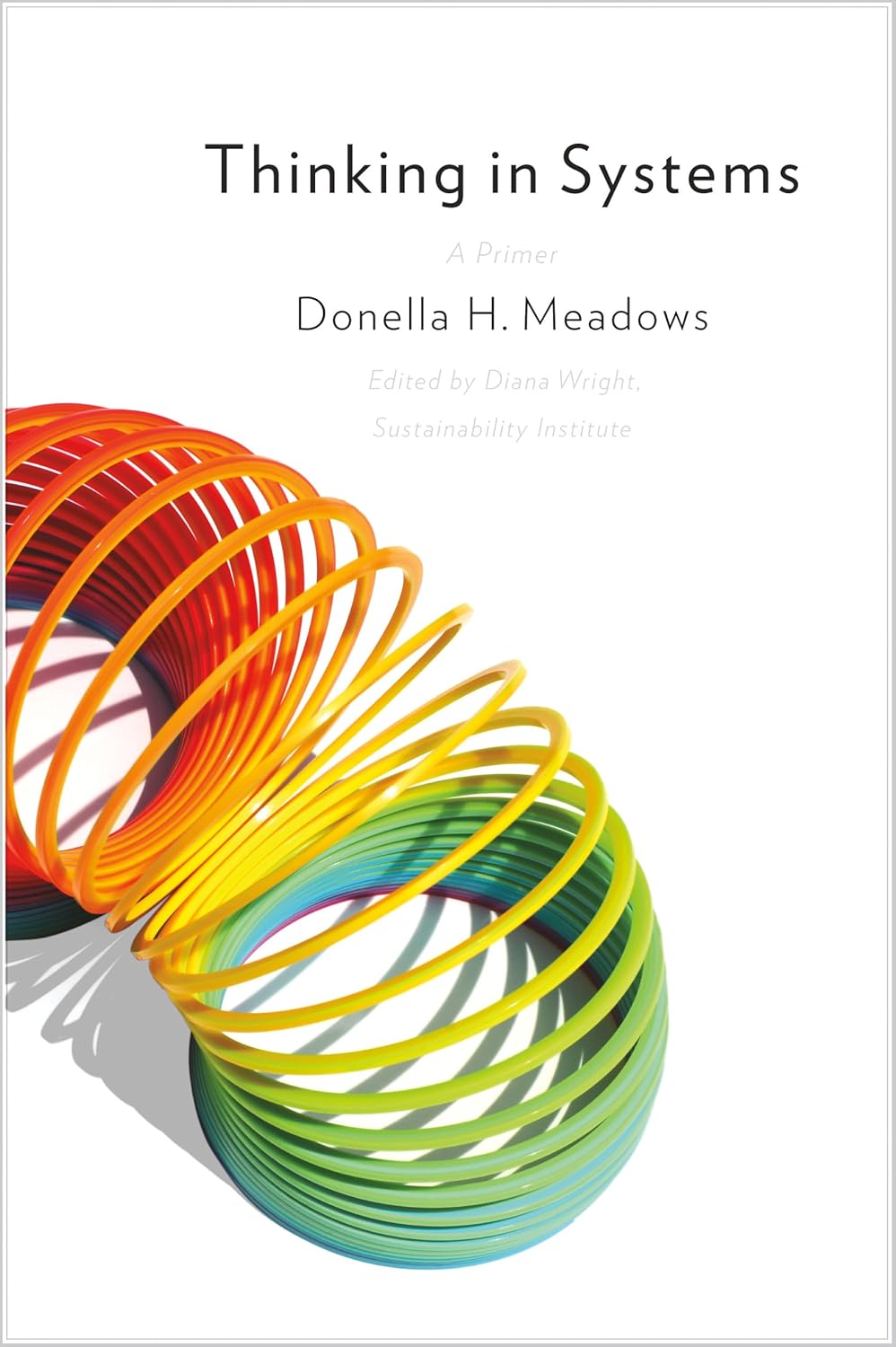
Thinking in Systems: International Bestseller
This is the book. If you only read one book on systems thinking, make it this one.
Donella Meadows was a pioneer—a scientist, writer, and systems analyst who co-authored Limits to Growth and spent decades teaching people to see the world differently. Thinking in Systems is her masterwork, published posthumously and refined over years of teaching and practice.
What makes this book extraordinary is its clarity. Meadows takes concepts that could feel abstract—stocks, flows, feedback loops, resilience—and makes them tangible. You will learn to recognise system archetypes in your own life. You will understand why solutions often backfire and how to find genuine leverage points for change.
With over half a million copies sold worldwide, this is the gold standard. It teaches you not just what systems are, but how to think within them. Forbes called it life-changing. Readers consistently describe it as the book that finally made complexity make sense.

The Fifth Discipline: The Art and Practice of the Learning Organisation
Peter Senge did something remarkable with this book: he brought systems thinking into the boardroom.
Published in 1990 and updated in subsequent editions, The Fifth Discipline introduced the concept of the "learning organisation"—an organisation where people continually expand their capacity to create, where collective aspiration is liberated, and where people learn to see the whole together.
Senge argues that organisations cannot afford to view themselves as mechanical structures where workers are cogs. That mindset kills curiosity on an individual level and blinds organisations to the value of their people. Instead, he introduces five disciplines: personal mastery, mental models, shared vision, team learning, and—crucially—systems thinking, which integrates the others.
The book draws on case studies from Apple, Harley-Davidson, Shell, and others. It is not just theory. It is a practical guide for leaders, managers, and anyone working within complex organisations who wants to shift from reactive firefighting to thoughtful, systemic change.
Practical Guides for Everyday Application
Turn theory into practice with actionable frameworks and mental models
Understanding systems conceptually is one thing. Applying that understanding to messy, real-world problems is another. These books bridge the gap.

The Systems Thinker: Essential Thinking Skills For Solving Problems
If Meadows gives you the philosophy and Senge gives you organisational strategy, Albert Rutherford gives you the toolkit.
The Systems Thinker is unashamedly practical. It focuses on mental models, archetypes, and frameworks you can apply immediately to workplace challenges, personal decisions, and everyday thinking habits. Rutherford does not assume you are running an organisation or studying environmental policy. He assumes you want to make better decisions, solve complex problems, and understand the forces shaping your life.
The book teaches you to ask better questions: What patterns keep repeating? What feedback loops are at work? Where are the leverage points? It provides systems archetypes—common patterns like "limits to growth," "shifting the burden," and "tragedy of the commons"—so you can recognise them when they appear in your work or relationships.
Rutherford also emphasises something crucial: systems thinking is not just about finding differences between elements. It is about finding similarities. This bi-directional analysis gives you a richer, more nuanced worldview.
For Tech Professionals and Engineers
Systems thinking applied to software, architecture, and complex technical environments
If you work in technology—whether as a developer, engineer, architect, or technical lead—systems thinking is not optional. Software is no longer isolated applications. It is ecosystems. Everything connects to everything else. Linear thinking breaks down. These books meet you where you are.

Learning Systems Thinking: Essential Non-Linear Skills and Practices for Software Professionals
Diana Montalion wrote this book specifically for you—the software professional navigating complexity, interdependence, and constant change.
We live in the systems age. Software professionals are no longer building isolated applications. We are building systems of software—interconnected, continuously deployed, responsive ecosystems. The old reductionistic approaches do not work anymore. Linear thinking fails when everything influences everything else.
Montalion guides you through this shift. She shows you how linear thinking limits your ability to solve systemic challenges. She identifies common obstacles to systems thinking and, crucially, shows you how to move past them. You will learn new skills and practices that transform how you think, learn, and lead.
This is not a philosophy book. It is a practice guide. Through real-world scenarios and concrete exercises, you will learn to shift your perspective, design better systems, and deliver better outcomes. Montalion also teaches you how to think well with others—because systems work is collaborative work.

The Phoenix Project: A Novel about IT, DevOps, and Helping Your Business Win
Sometimes the best way to learn systems thinking is through a story.
The Phoenix Project is written as a novel, but do not mistake it for light reading. It is a systems thinking masterclass disguised as a business thriller. The protagonist, Bill, is an IT manager at a failing company. He has 90 days to save a critical project—or his entire department gets outsourced.
What unfolds is a demonstration of systems thinking in action. With guidance from a mysterious board member, Bill learns that IT work has more in common with manufacturing than anyone realised. He discovers bottlenecks, work-in-progress limits, feedback loops, and the importance of flow. He learns to see the whole system, not just isolated incidents.
The book is based on The Goal by Eliyahu Goldratt, which introduced the Theory of Constraints to manufacturing. Kim, Behr, and Spafford apply those principles to IT, DevOps, and modern software development. The result is a book that anyone working in technology will recognise—and learn from.
For Tackling Global and Complex Challenges
Systems thinking applied to climate change, wicked problems, and societal-scale issues
Some problems are too big, too interconnected, and too urgent to approach with linear thinking. Climate change. Inequality. Biodiversity loss. These are not problems you can "solve" by fixing one piece. They require systemic intervention at multiple levels simultaneously.

Systems Practice: How to Act in Situations of Uncertainty and Complexity
Ray Ison wrote this book for a world in crisis.
We live in the Anthropocene—the age where humans are a geological force, affecting whole-earth dynamics including the climate. Our institutions feel fragile. Our problems feel overwhelming. Linear, reductionistic thinking cannot address challenges this complex and interconnected.
Systems Practice is both a call to action and a guide. Ison argues that we urgently need to recover our systemic sensibilities, foster systems literacy, and invest in systems thinking at every level—personal, community, organisational, national, and international.
This is a more academic book than the others on this list, but it is deeply practical. Ison introduces systemic inquiry, systemic action research, and systemic intervention. He shows you how to act in situations where uncertainty and complexity dominate—which, increasingly, is everywhere.
If you care about climate change, governance, public policy, or societal-scale challenges, this book gives you the tools to engage meaningfully rather than feel helpless.
How to Approach This Reading List
You do not need to read these books in order. You do not need to read them all. But you do need to be intentional about which you choose and why.
If You Are New to Systems Thinking
Start here: Thinking in Systems by Donella Meadows. This is the foundation. Read it slowly. Let the concepts settle. Try to see the systems around you—in your work, your relationships, your habits.
Then read: The Systems Thinker by Albert Rutherford for practical application, or The Phoenix Project if you work in technology and prefer learning through narrative.
If You Lead or Work in Organisations
Start here: The Fifth Discipline by Peter Senge. This book will change how you think about teams, culture, and organisational learning.
Then read: Thinking in Systems for conceptual grounding, and The Systems Thinker for practical tools.
If You Are a Tech Professional
Start here: Learning Systems Thinking by Diana Montalion. This book speaks your language and addresses your challenges directly.
Then read: The Phoenix Project for a narrative demonstration of systems thinking in IT, followed by Thinking in Systems for deeper conceptual understanding.
If You Care About Global Challenges
Start here: Thinking in Systems for the foundation, then move to Systems Practice by Ray Ison for tools to engage with complexity, uncertainty, and wicked problems.
Beyond the Books
Reading about systems thinking is valuable. Practising it is transformative.
These books will give you concepts, frameworks, and examples. But systems thinking is not something you learn once and file away. It is a practice. It requires observation, reflection, and application. It requires you to slow down, pay attention to patterns, and ask better questions.
If you want to go deeper into systems thinking, my book Wired for Innovation: Thinking, Building and Growing in a World Shaped by Technology explores how systems thinking applies to technology, work, and navigating disruption in the age of AI. Learn more about the book here.
Start with one book. Let it change how you see. Then choose another. Over time, you will notice something shifting—not just in how you think, but in how you navigate complexity, solve problems, and understand the world.
The systems were always there. You are just learning to see them.