

The Optimal Approach to Learning via Video Tutorial
Most people watch a tutorial and start copying it straight away. It feels like the keen thing to do. But it asks your brain to do several hard jobs at once, and a small change in order can make a big difference to how much you keep.
If you have ever followed a video step by step, finished every instruction, and then found the next day that most of it had vanished, nothing is wrong with you. You did what almost everyone does. The method is the problem, not your effort or your intelligence.
To see why, we need to look at one of the most useful ideas in learning science: the mental model.
Mental Models: The Platform Your Brain Needs
New information does not settle in your mind by itself. It has to connect to something you already know. Without that connection it has nothing to hold on to, and it fades.
Psychologists call these structures schemas, or more simply mental models. A mental model is your internal picture of how something works. It lets you make sense of a new situation, guess what comes next, and file what you learn in a way you can find again.
Think of a complete beginner watching a Python tutorial. Variables, indentation and loops all arrive with nothing to attach to. The beginner is not just learning facts. They are building a mental model from nothing, in real time, while also watching, listening and trying to type. That is a heavy load, and it is why so little sticks.
Now think of an experienced developer watching a tutorial on a new library. They already have the picture of how programming works, so the new material slots straight in. The gap between the two people is not intelligence. It is whether a mental model is there to receive the lesson.

New knowledge needs an existing framework to hold on to. Without one, even a clear explanation struggles to become lasting memory.
How Mental Models Grow
A mental model is built through repeated exposure, not in a single sitting. Psychologists describe two steps. First you fit new information into what you already know. Then, when something truly new does not fit, the model itself has to change. Both take time, and neither finishes in one tutorial.
This matters for anyone starting something new. The first time you watch a tutorial, much of what you are doing is building the mental model itself, not yet learning the details inside it. Trying to build that structure and use it at the same moment is why watch-and-do so often disappoints.
How Knowledge Builds on Earlier Models
1. Foundation. Your general sense of how the field works. For programming, that computers follow instructions. For 3D modelling, that objects have shape, light and material.
2. Framework. The map of the field. Variables, functions and loops in programming. Vertices, edges, faces and modifiers in 3D. This layer lets new lessons connect to what you know.
3. Technique. The specific skill in the tutorial. It only holds well once the framework underneath is ready for it.
4. Practice. Doing the technique yourself. Most tutorials start here, and most learners jump here. It is really where the process ends, not where it begins.
So before a tutorial on a specific technique, ask yourself whether you have a good picture of the wider field. If you do not, your first viewing is building that picture, and that is valuable work even if you remember little of the detail. Research suggests that when learners lack background knowledge, their learning tends to be fragmented. The answer is not to concentrate harder on the first viewing. It is to let the first viewing do its real job, then return once the groundwork is in place.
Why Doing Everything at Once Fails
Even with a good mental model, you can only actively process so much at one moment. The space where this happens is called working memory, and it is small.
Cognitive Load Theory describes three demands on it: the difficulty of the material itself, distractions and poor design around it, and the effort of building lasting understanding. When you watch a tutorial, run the software, fix errors and follow instructions all together, those demands compete, and very little is stored well.
Watching without following along is not lazy. It is a deliberate way to cut the extra load, so your brain can spend its full capacity on understanding the idea and building the model.
When the material, the software and the effort of understanding all compete at once, working memory fills up and the quality of learning drops.
How Sleep Turns Watching Into Skill
A third process matters just as much, and most learners never plan for it: memory consolidation during sleep.
New information is first held in a part of the brain called the hippocampus. To become a stable long-term memory, it has to be linked into the wider network of knowledge in the cortex, which is where your mental models live. A great deal of that linking happens while you sleep. This is one reason a skill practised in the evening often feels smoother the next morning.
Spacing your learning out gives this process room to work, and studies find it usually beats cramming everything into one session. Studies also suggest that simply watching a skill, with no pressure to perform, can prime the brain for later practice. The groundwork starts during observation, so when you do start practising, part of the way is already done.

During sleep the brain replays new memories and links them to what it already knows. Longer or harder study cannot replace this step.
The Method: Watch, Sleep, Then Do
With mental models, cognitive load and sleep in mind, the approach follows naturally. It is not a shortcut. It is a simple order that matches how the brain builds understanding.
Step 1: Watch the whole video and do nothing else
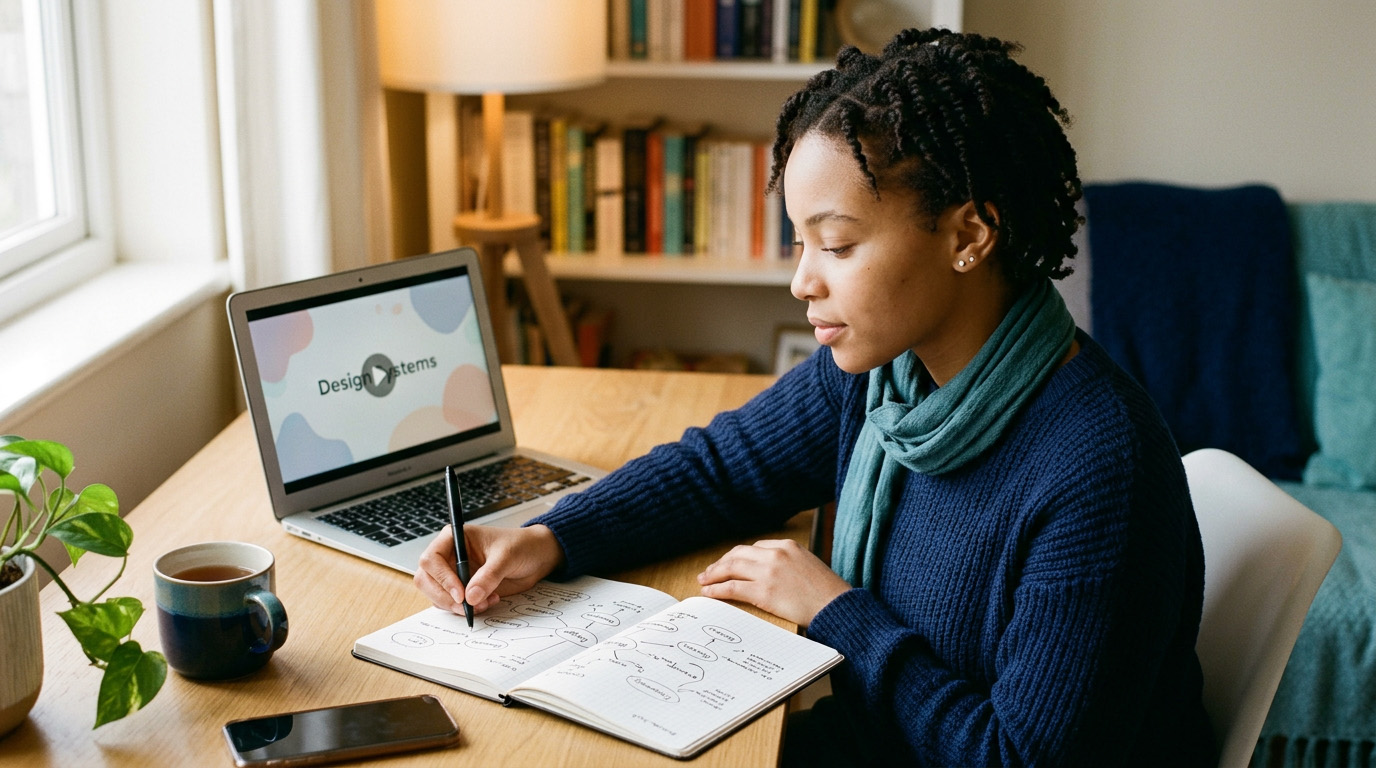
Play the tutorial from start to finish. Do not open the software, and do not pause to try the steps. Note a word or two at most. Your only job is to take it in, which frees your working memory to follow the logic and the overall shape of what is being taught. You are building the picture before you try to use it.
Step 2: Leave it for at least a day, and sleep on it
Step away and allow at least one night's sleep before you practise. Your brain will replay and strengthen what it saw, and fit it into what you already know. You do not need to think about it. What feels like doing nothing is some of the most useful learning time you will have.
Step 3: Watch again, and this time follow along
The second viewing will feel different. The material is no longer entirely new, because your brain has already worked on its shape. Open the software, follow the steps and pause when you need to. Now you are applying knowledge to a framework that is ready, not building the framework and using it at the same time.

Observation builds the model, sleep strengthens it, and practice applies it. Squeezing all three into one sitting skips two of them.
When the Material Is Complex or Unfamiliar
Not every tutorial is equally demanding. A short video on one tool in a field you know well is very different from a deep dive into a new way of thinking, such as a new programming style or an animation pipeline you have never seen. The less you know about the field, the more viewings you need before practice becomes useful.
For difficult or dense tutorials
- Watch the video at least twice without practising, with a night's sleep between the viewings if you can.
- On the second viewing, you will spot links and details that were invisible the first time. That is the mental model taking shape.
- Open the software only on the third viewing, when your understanding is strong enough to carry the practice.
- If the tutorial covers several separate ideas, split it into parts and use the method on each part in turn.
Education research makes the same point: students learn new ideas by linking them to what they already know, and the order in which material arrives has a big effect on what is kept. When you teach yourself from videos, you are in charge of that order, and the method above gives you a simple way to manage it.
Why It Feels Wrong, and Why That Is Fine
Watching without doing feels passive. Waiting a day feels slow. The urge to open the software while the video is still playing is strong, especially if you are keen and energetic.
But that urge is what leads to the frustrating cycle of watching the same tutorial again and again without the skill ever arriving. The discomfort of holding back is not a sign the method is wrong. It is a sign that you are putting what your brain needs ahead of the feeling of being busy.
Anything worth understanding needs a platform to stand on, and that platform is your mental model. Building it takes time, repetition and rest.
The Core Idea in Short
Watch first. Build the picture. Sleep. Then do. For harder material, watch twice with a night between, then practise.
A Different Way to Learn
This approach asks for a change in mindset as well as method. It asks you to treat watching as real learning and not as a warm-up. It asks you to accept that building a mental model is learning in itself, that rest is part of the work, and that your second viewing will feel different from your first because of what happened in between.
If you are learning programming, 3D modelling, systems design or any other technical skill from videos, the change is worth a little discomfort. The method is not slower. It is more efficient, because what you learn lasts.
Build the model first. Let sleep do its part. Then apply it, and see how it feels when learning sticks.
Where the CulerLearn App Fits In
I built the CulerLearn app around this way of learning, so you do not have to organise it all yourself. The lessons are short cards that take a few minutes each, not long videos to sit through, so it is easy to take in one idea, stop, and let it settle.
- Small steps. Each card holds one idea, so you can learn in short sessions and come back to it the next day.
- Tasks that make you think. Short tasks ask you to put an idea in your own words, which is the practice stage of the method, in a form you can finish on your phone.
- Reminders at the right time. Add an action to My Actions and the app reminds you on the day, so the second viewing and the practice do not get forgotten.
- Your answers stay with you. They are saved on your own phone, and you can pick up whenever it suits you.
The website courses work well too. The app simply puts the method in your pocket, with the guidance and the reminders built in.
