When Your Agent Talks to Their Agent
- Date 6 November 2026
- Categories Artificial Intelligence, Robotics
- Comments 0 comment
When Your Agent Talks to Their Agent
A personal AI agent for everyone is not a distant idea. The infrastructure for it is being built right now. What has had far less attention is a quieter question sitting underneath it: if our agents start doing the talking, how much of our own talking do we quietly stop doing?
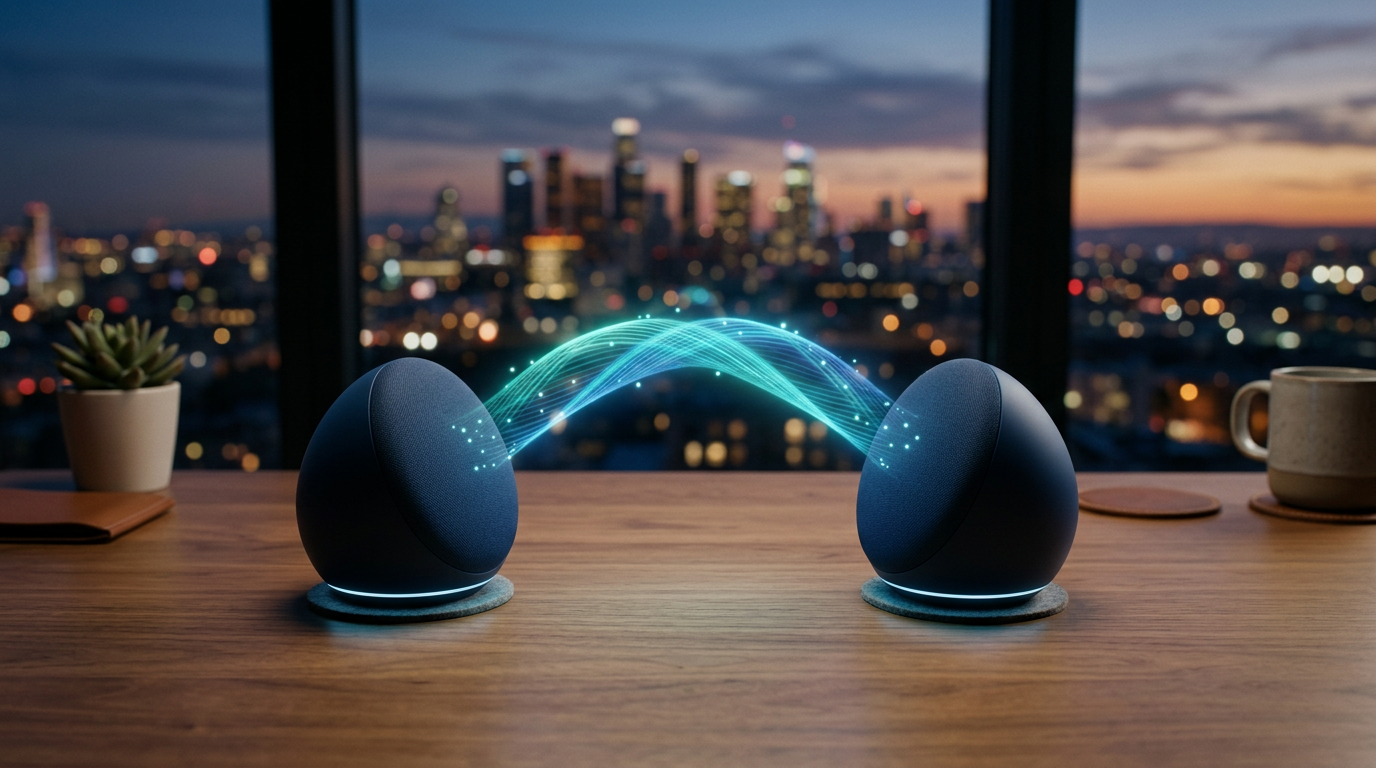
Picture a fairly ordinary near future. You need a dinner reservation, a refund processed, a meeting rescheduled across three time zones, a quote compared against two competitors. Instead of doing any of it yourself, you tell your personal AI agent what you want, and it goes and sorts it out - talking not to a human, and often not even to a company's website, but to another AI agent representing the other party. Two pieces of software negotiate a small transaction. Neither person involved says a word to the other.
Multiply that by every small transaction, message, and negotiation an average person handles in a week, and a genuinely open question appears: does this simply remove friction from daily life, or does it quietly begin to replace something we haven't fully appreciated the value of - the plain fact of one person dealing directly with another?
A note on how to read this piece: this is a genuinely contested question, and reasonable, well-informed people land in very different places on it. What follows is not an argument for or against personal AI agents. It is an attempt to lay out what is actually being built, why it is appealing, what the real trade-offs look like, and the questions worth asking - so you can weigh it for yourself, rather than being told what to conclude.
The Vision: What Personal Agents Could Do
The appeal is straightforward. A personal AI agent that genuinely understood your preferences, your calendar, your budget, and your priorities could handle a large share of the small, repetitive interactions that currently take up real time and mental energy:
- Negotiate on your behalf - comparing prices, terms, or availability across multiple providers, and settling on the best outcome without you needing to have the conversation yourself.
- Handle routine correspondence - replying to messages that follow a predictable pattern, scheduling and rescheduling, confirming logistics, chasing things that are overdue.
- Filter what reaches you - deciding which of the hundred things vying for your attention today are genuinely worth your direct involvement, and quietly resolving the rest.
- Represent your interests in transactions - dealing with a retailer's, a service provider's, or another individual's own agent, so that two systems handle the back-and-forth that two people would otherwise have to.
- Learn and adapt over time - becoming more accurate about what you would have decided yourself, reducing the number of things that need your direct attention at all.
For anyone who has ever spent forty minutes on hold, or sent six emails to schedule one meeting, the appeal is obvious. The promise is not that AI replaces judgement, but that it absorbs the mechanical parts of daily life that were never really about human connection in the first place.
What People Stand to Gain
The genuine case for personal agents rests on time and cognitive load. Most people already delegate small decisions - to spam filters, to autocomplete, to recommendation systems - without thinking of it as delegation at all. A more capable personal agent is, in this framing, simply doing more of what we already quietly outsource: handling the transactional, repetitive, low-stakes interactions so that time and attention can go toward the interactions that actually benefit from being personal.
The Technical Reality
This is not a speculative scenario sitting years away. The infrastructure for agents to talk to other agents, rather than to websites built for humans, is being actively standardised right now. Protocols with names like MCP and A2A exist specifically to let one AI agent discover what another agent can do and hand off a task to it, the same way early internet protocols let computers that had never met exchange information reliably.
Industry analysts have suggested that a significant share of enterprise software will integrate AI agents within the next couple of years, and international standards bodies are already working on formal specifications for how agents identify themselves and communicate safely. Some payment processors and financial platforms report that a majority of their automated data requests already originate from agents rather than direct human use. None of this is confined to one company or one product. It is best understood as an emerging layer of infrastructure that a great many organisations are building toward simultaneously.
The practical effect is that the scenario described at the start of this piece - your agent quietly negotiating a booking with a restaurant's agent - is not a hypothetical extrapolation. It is closer to a description of systems already being piloted.
A Pattern Already Being Debated: The "Dead Internet" Question
There is already a live, if contested, conversation about a related phenomenon, sometimes called the "dead internet" idea. It began as a fringe theory - the claim that much of what looks like online activity is no longer produced or consumed by real people, but generated and exchanged by automated systems. For a long time, it was treated as an internet curiosity, not a serious observation.
That has shifted somewhat. There is now measurable data showing a substantial share of content on some major platforms is automatically generated, and reports that automated web traffic has, at certain points, outpaced traffic from actual human visitors. This is worth stating plainly: it is genuinely disputed how much weight this evidence should carry, and serious commentators disagree sharply about whether it describes a real structural shift in how the internet works, or an overstated framing of a much more mundane trend in automation.
Why This Matters for the Personal Agent Question
Whatever view one takes of the "dead internet" framing specifically, it points at something directly relevant here: a growing share of interactions that look like they involve a person on the other end may not, in fact, involve direct human participation at any point. Personal AI agents are not the cause of that trend, but they are a natural extension of it - moving the pattern from public content and customer service into the private, everyday transactions of ordinary people.
The Concerns Worth Taking Seriously
Whatever position one takes on whether this is a positive development, several specific concerns come up consistently in serious discussion of agent-mediated interaction, and they deserve to be considered on their own terms rather than dismissed as generic technology anxiety.
The Erosion of Direct Interaction as a Skill
Negotiation, small talk, reading tone, resolving a minor disagreement - these are things people get better at through practice. If a meaningful share of daily interactions are quietly handled by an agent instead, there is a real question about what happens to those skills over time, particularly for people who grow up with agents handling this from the start rather than gradually adopting them as adults who already practised the skill directly.
Asymmetry and Manipulation
An agent negotiating on your behalf is only as good as its training, its access to information, and the incentives of whoever built it. A more sophisticated agent representing one party could systematically extract better outcomes from a less sophisticated agent representing another, in ways that are much harder for either human to notice than an unfair negotiation conducted directly. The asymmetry moves from being between two people, who can at least sense when something feels off, to being between two systems whose internal reasoning neither person can fully see.
The Accountability Gap
When two agents reach an agreement, a booking, or a transaction on behalf of two humans, and something goes wrong, responsibility becomes genuinely harder to locate. Was it the user's instruction, the agent's interpretation of that instruction, the other party's agent, or the underlying model's limitation? Existing frameworks for resolving disputes between people, or between a person and a company, were not built with this structure in mind.
Homogenisation of Voice and Outcome
If a large number of people rely on similar underlying agent systems to negotiate, communicate, and decide on their behalf, there is a plausible risk that outcomes converge - the same phrasing, the same negotiating positions, the same categories of compromise - in a way that quietly narrows the range of genuinely individual expression and decision-making, even though each person believes their agent is acting uniquely on their behalf.
Data Concentration
An agent that can act well on your behalf needs deep, ongoing access to your preferences, your calendar, your financial limits, your relationships, and your communication style. This is a meaningfully larger and more intimate body of personal data than most current digital services require, concentrated with whichever organisation provides the agent.
Economic Disruption to Interaction-Based Work
A significant amount of paid work already consists of exactly the kind of mediated communication, negotiation, and coordination that personal agents are being built to handle - customer service, scheduling, sales negotiation, basic dispute resolution. The economic effect on people currently doing that work is a real and immediate consequence, not a distant hypothetical.
What Meaningful Human Control Would Need to Look Like
If personal agents become as capable and widespread as current investment suggests they might, the question of control becomes central rather than incidental. A few conditions come up repeatedly in serious discussion of what responsible design would require:
- Full visibility into what the agent has done on your behalf - not a technical log, but a plain account of every decision, negotiation, or commitment made in your name.
- A genuine, low-friction option to intervene directly - the ability to step back into any interaction the agent is handling, at any point, without having to override or fight the system to do so.
- Clarity to the other party - some visible signal, to the human or agent on the other side of an interaction, about whether they are dealing with a person or a system acting on that person's behalf.
- Data limited to its purpose - the agent holding only what it needs to act well, rather than an open-ended, ever-growing profile of everything about you.
- Portability - the ability to move your preferences and history to a different agent provider without starting from nothing.
- An unconditional ability to switch it off - and continue participating in ordinary digital and commercial life without the agent, not just in theory but in practice.
Possible Models for How This Develops
There is no single settled path for how widespread agent-to-agent interaction actually unfolds. A few distinct directions are worth setting out, since they carry quite different implications.
Model A - Agent as Filter
The agent screens, summarises, and prioritises, but the person still directly handles anything beyond routine confirmation. Most communication remains human-to-human; the agent simply reduces noise beforehand.
Advantages
Preserves direct human interaction as the default. Lower risk of accountability gaps, since the person remains the one actually deciding and communicating. Easier to understand and to trust.
Limitations
Delivers a smaller share of the time-saving that makes personal agents appealing in the first place. Commercially less compelling to providers who benefit from higher agent autonomy.
Model B - Agent as Delegate
The agent handles routine interactions fully and independently - bookings, standard negotiations, scheduling - and only escalates to the person for anything unusual or high-stakes.
Advantages
Captures most of the practical time saving. Keeps human judgement in reserve for the interactions that genuinely need it, rather than removing it entirely.
Limitations
Depends heavily on the agent correctly judging what counts as "routine" versus "needs a person" - a genuinely hard problem to get right consistently.
Model C - Full Agent Mediation by Default
Agent-to-agent interaction becomes the default channel for most transactional and coordination tasks, with direct human interaction becoming a deliberate, opt-in exception rather than the norm.
Advantages
Maximum efficiency and time saved. Consistent with where current infrastructure investment and commercial incentive appear to be heading.
Limitations
Carries the largest version of every concern raised above - skill erosion, accountability gaps, data concentration, and economic disruption, all at scale.
Model D - Regulated, Interoperable, and Transparent by Design
Agent-to-agent interaction is permitted and standardised, but governed by open protocols, mandatory disclosure of agent involvement, and independent oversight, regardless of which company built the underlying agent.
Advantages
Addresses the accountability and transparency concerns directly, rather than leaving them to individual providers' goodwill. Avoids concentration of this capability within a small number of organisations.
Limitations
Slower to establish, since it depends on regulatory and standards coordination across many jurisdictions and companies, and technology is likely to move faster than that coordination can keep pace with.
What Different Groups Stand to Gain or Lose
For individuals: Time and reduced cognitive load, weighed against a real question about what is lost when repeated small interactions no longer require any direct human effort at all.
For businesses and service providers: Lower cost of handling routine customer interaction, weighed against a shift where their own agents must now negotiate with a customer's agent rather than the customer directly - a fundamentally different kind of interaction to design for.
For people currently doing interaction-based work: A direct and immediate economic question, not an abstract one, since much of this work is precisely what personal agents are being built to handle.
For infrastructure and platform providers: A genuinely large emerging market, alongside significant responsibility for how much transparency, control, and interoperability gets built in from the start, given how much of this is still being decided now rather than later.
For regulators and standards bodies: An unusually early opportunity to shape norms before they calcify, but also a genuinely difficult coordination problem across many jurisdictions and rapidly moving technology.
For society more broadly: A real, open question about whether reducing the friction of daily transactional life comes at the cost of something less measurable - the ordinary, low-stakes practice of dealing directly with other people that has, until now, simply been a background feature of everyday life.
A Middle Path Worth Naming
The choice does not have to be binary between full agent mediation and none at all. Several intermediate approaches are already being discussed seriously:
- Mandatory disclosure - a simple, visible signal whenever an interaction is agent-mediated on one or both sides, so nobody is uncertain whether they are dealing with a person.
- Reserved categories for direct interaction - certain kinds of decisions or relationships explicitly kept outside agent mediation by design, not left to individual discretion in the moment.
- Graduated autonomy - agents earning greater independence over time as their track record on a given task type is demonstrated, rather than being granted full autonomy from the outset.
- A standing right to a human - the ability to request direct human interaction at any point in any agent-mediated process, honoured as a default expectation rather than an inconvenience to be designed around.
The Deeper Question
The more interesting question may not be whether personal agents can do these things well. On present evidence, it looks increasingly likely that they can. The harder question is whether a large share of daily human interaction quietly becoming agent-to-agent by default changes something about how people relate to one another that is not easily recovered once it has shifted - or whether this is simply the latest, and eventually unremarkable, step in a very long history of automating the mechanical parts of life so that people can spend their attention elsewhere.
Both of those views are held by serious, informed people. Neither is obviously wrong.
The Bottom Line
Personal AI agents capable of interacting with other agents on our behalf are being built now, by many organisations simultaneously, using increasingly standardised infrastructure. This is not a distant hypothetical. What remains genuinely unresolved is how much of ordinary human interaction moves behind that layer, how visible and reversible that shift is for the people it affects, and who is accountable when it goes wrong.
This piece has deliberately not argued for a particular answer to those questions, because there isn't yet a settled one. It is worth forming your own view before the infrastructure now being built quietly becomes the default you never explicitly chose.
Whether this becomes a quiet convenience or a significant shift in how people relate to one another will likely depend less on the technology itself, which is advancing regardless, and more on the transparency, control, and standards put in place while it is still being built. That window is open now, not later.

You may also like